Problem Solution Paper of Current Issues in ELT


CHAPTER I

Current Issues of English Language Learning


Nowadays, It is no doubt that English language learning (ELL) has spread in almost all the coutries in this planet and dominating a number of fields including education, business and politic. Investigating ELL as an issue is a topic that has been gaining significance in educational system throughout the world where essentially many countries put English as an urgent subject of almost daily routine classroom. Although the innovative methods of ELL have spread over the last one decade, ELL in this twentieth-first century still undergo numerous problems and issues in process.
In a large scale of research, Choi and Lee (2008) has surveyed across 18 Asian nations/regions. The result showed that most of the primary teachers in Asian regions teach all subjects including English language learning. Interestingly these teachers have lacks training in English Language Teaching (ELT). On the other hand the use of English as medium of instruction in many asian countries is still far from the expectation. As shown in the table 1 below, there are only Malaysia, Singapore, Srilangka, and India who actively use English as medium of instruction in school. Another result, the research also found several issues in process such as sociocultural, educational policies, class size, curriculum, teaching methods and qualitites both of students and teachers.

School level
Countries
Primary classes
Malaysia, Singapore, Sri Lanka, and India (only in English medium schools), Korea (only in immersion programs), the Philippines
Junior Secondary classes
Malaysia, Singapore, Sri Lanka, India, Hong Kong (in English-medium schools), Indonesia (in bilingual programs), Thailand (in English programs)
Senior Secondary classes
Malaysia, Singapore, Sri Lanka, India, Korea (only in specialized schools, e.g., international high schools) the Philippines, Hong Kong (in English-medium schools), Indonesia (in bilingual programs), Thailand (in English programs), Pakistan
Tertiary classes
Malaysia, Singapore, Sri Lanka, India, Korea (in several universities, especially top universities), the Philippines, Hong Kong, Indonesia (in international programs), Thailand, Pakistan, Taiwan, Bangladesh, Israel, the UAE, China (very few courses in top universities)

Table 1


Furthermore, the data is taken from 2008 and only depicted general issues in several country. Aspect like methods and teachers qualitites have been tried to be enhanced along this period and still nothing of significance change happens, then there must be some specific error in the educational process. The writer argues that many issues and aspects should be investigated in accordance to ELL.

Other way of looking into general perspective, it is better to sort some specific issues of ELL which the researchers and many experts concern about and also give specific explanation to overcome these issues at the next chapter of this paper. Below there will be a brief descriptions of each issue which the writer have recognized. Essentially there are nine issues in English Language Learning process;

A. Teachers’ creativity

As this framework suggests, one of the features belong to teacher qualities is the teachers’ creativity. The way of teachers manage the material and convey their instruction have determined the way of students’ achievements from the material. Currently, many researchers in an EFL country, for instance Al-Qahtani (2016) and Filimban (2010) argued that teachers who practice approaches and methods that do not promote creativity will cause the students’ low level of achievement in English class. The writer considers that the teachers who have less creativity as a prominent issue toward ELL since most the students input is based on the teacher. However most of the teachers use whatever methods and techniques they have under their subjects whereas every subject especially English should be taught with an appropriate technique which covers both enjoyable and educative. And all of those at least need a creativity to realize it.

B. Teachers’ Feedback

Feedback from teacher is also considered as an urgent issue in this account. English language contains complexity of the material and with this in mind, the teacher are expected to give more inputs in form of giving contributions to their students. We cannot also judge that all of the roles depend on the teacher, but a good teachers’ traits is to manage and to support the students. If we look at the current trend in this era of English learning, the teachers seem less of taking role in every part of students’ acitivites, as the time passed they mostly show inconsistent attitudes. Accordingly, a research (KoƧ, 2012) found that the higher the grade level is, the less important the characteristics such as teachers’ being experienced, assigning homework, praising students, communicating with parents, designing song and game activities, and also taking students’ views into consideration.

C. Teachers Explanation

Students in EFL country often hypnotize themselves that English is the most difficult subject. In related case the students do not even realize that actually the platitude explanation of teachers influence the students to have such thus thinking. Still fresh in writer’s memory, in the end of the course the teacher sometimes say is there any question?. Perhaps some of the students would say no sir, indicated they already understand but some others not. The logical reason of the latter students condition is they feel confused about the teachers’ explanation so what should they ask for? Moreover the material is unclear and students often face dilemma of what to do, or do the wrong thing. Recently, some researches have proven that in this decade the teachers had poor organization skills to their instructional (Naeem, 2014). Into more specific case, we may find in daily classroom teachers delivered the material in low voice, in which it triggers the students' boredom and classroom noise (Bahanshal, 2013).

D. Students Lack of motivation

In learning English, the students are required to engage actively at every single activity including listening, writing, reading and performing speaking in a small classroom. The problem is, not all students want to compete to each other in which represent they clearly have different motivation or purpose for learning English. Some of them considered at English just as a course that should be passed and do not understand its importance as a means of communication. For most students, learning English is a duty, something that they have to, but do not want to do. They do not see pleasure in learning English. These students have low motivation to participate in class, and they simply try to get a passing mark to get rid of the course.

E. Mother Tounge Use

ELL students come from very different backgrounds and often face multiple challenges in the classroom, especially in Indonesia which has many tribes spread along the islands. By the variety of dialects, the students who want to learn English usually influence by inherent structure of their first language or mother tongue that they are exposed to since the first day. Learners find that it is easier to express themselves in their native language. Basically, the students cannot deny when been asked a question in English, they first translate it into their mother tongue and after they understand the question, their brain make an aswers in their mother tongue, then translates it again into English and they reply thereafter. It is the weaknesses of living in non-native area where the students are not used to thinking in English.

F. Lack on Vocabularies and Poor on Reading Books at Library

Today’s English formal classes is different from what on the mid to late twentieth century where the focus is no longer on memorizing forms of verbs, nouns, adjectives, pronouns and grammatical. Accordingly, there are signs that this is going to be disappeared someday because of the new trends in language learning nowadays which enable us to learn and read innovative material on internet. School library seems to become remote because of fact that young adults and older teens are prefer to use technologies to read (Rainie, 2016). As a matter of fact, reading books in library is essential and can be so powerfull tool to many aspects of learner necessity. In old time our ancestor always suggest us to keep reading a book in library, and the writer also agree with that since not everything on the internet is true.

G. Minimum Authentic Material

Currently, the problem in ELL is that too much is focused on the form of interaction while the nature of it is ignored in this case a material a central of learning. A big problem in English language teaching which the students encounter is that the material is still unusual, and the worse, the teachers alienate the material instead of looking into the context. English language learning should be authentic in order to assimilate the students understanding between the course and their culture.

H. Learning English can harm local language

Across the globe, minority languages are facing extinction in the face of globalisation. According to Unesco, half the world’s 6,000 languages face being wiped out by the end of the century, including 150 from Europe. The endangered languages include Quechua, which is spoken, primarily in the Andes in Colombia to Chile. Prof Rosaleen Howard, of Newcastle University explained: “When people move from rural areas to the cities they need Spanish in order to get jobs and education; there is no alternative. The people who push for language revitalisation tend to be the more educated people who are bilingual.”

I. Isolated Learning English

The main obstacle for learning English is that there is no environment that makes the students familiar with the original language. Despite all the money, efforts taken and time spent, EFL students are still not as successful in learning English as they are expected. In most of EFL classroom treat English as a school subject, which is the worst way to learn a language. In fact the government policies seems inferior to compete with the private.

CHAPTER II
Solutions of the Issues in English Language Learning

In this section the writer provides solutions for several issues in the previous chapter which can be solved with the presence of literary works. A key point may underlined several solutions and elaborated in a way that can cover some issues as stated in chapter one.

A. Using Authentic material in Classroom Teaching (Local-based literature)

Due to the growing interest in and uptake of English learning applied in classroom, many teachers are blinded with international trends of teaching method instead of looking further into the material. Generally speaking, a language is most effectively learned in the context of motivating themes and authenthic materials where the students live with. We need to think about the content where every country in a city or rural area provide abundance materials to be used as relevant authentic material. The teachers used them to improve four essential skill (e.g speaking, listening, writing and reading) in English learning.

In addition to responding the latter statement, unmotivated students would say:

“What is actually the point of learning English. Reading skill may be used for reading restricted content, writing skill only looks cool when used as graffiti or drawing on a wall street and honestly what is the point of slang?”

And another one would probably say;

“It is cystal-clear that many valuable things we can do than learning English, practically all we need to do is concerning about Global Issues: AIDS, war in Palestine, Irak, or some contries which have conflict with another countries, Global warming, natural and human-made disasters are the real issues. So what has this to do with the teaching of English?”

The answer of both statements have been clearly voiced by the British educator Maley (1992);

English language teaching (ELT) has been bedeviled with three perennial problems: the gulf between classroom activities and real life; the separation of ELT from the main stream of educational ideas; the lack of content as its subject matter. By making Global Issues a central core of EFL, these problems would be to some extent resolved.

Generally speaking, the teachers also be responsible for this respect. They do not have to look at the global perspective, yet to build their creative thinking and action they are required to raise at least their local issue as their main material to teach English. We may find in several textbook that many chapters provide activities based on the of western style. Why don’t teacher create their own English textbook which include their local issues and develop innovative activites which integrated with local games. It can be in form of fiction story, poem, puns or even adapted from local literature. It is paradoxically poor to see how the literary works are more famous in another country other than where it is born. The teachers do not preserve their own culture by teaching literature toward their students. La Lagaligo for instance, which claimed as the longest literary works in the world by the Dutch, which originally do not come from Netherland but Buginese craft.

The writer does not blame people who do not know their local literary works. We need to think positively and plan it for least five years from now after all. Researching our culture endlessly, asking our parent that his parent ever told them from their ancestors including habits, stories, or other literary works that are relevant for the students need, again and again untill we finally find it and apply it. We do not need to worry wasting our time in a searching for appropriate material for the students. Rather than stuck in this era and English is still the most difficult subject for students.

The students are really interested on two things, new experiences and their experiences. They enjoy their lesson and create a positive atmosphere in a classroom. In an ideal classrom situation sometimes we may hear the students say in words that promoting literary works appreciation. “wow I feel ever experience that before, but I don’t know where.” or something like “this is amazing, I probably never think with the same way again”. It is something that many teacher, instructor or tutor want hear from that students. Students are motivated in a case when they think that they ever experience that issues, it will absolutely evoke their appreciation toward the literary works. For the teacher, positive respond from the students will psychologically give contribution such as enthusiasm, self efficacy or even it triggers them to make new approach initiatively.

Talking about suitable approach in literature in accordance with authenthic material, students are more apt here to be trained on a new approach because most of the classroom problems are more abstract. The teacher may choose an interesting literary work such as urban stories and translate them into English, yet they have to select them carefully, because authentic material is no longer authentic for the students if the students showed passive responds. At last, the material can be categorized as authentic apparently is based on the teachers’ explanation and manage the material.

In addition to what best idea to present literary works, it is recommended to create an original way which is fit with teacher’ personality, rather than searching on the internet with a keyword innovative learning of 2017 and does not fit with the students’ interest and need. This is why the writer never suggests specific approaches in this paper because he claims that there is no actually bombastic technique in relation to English language learning in this twentieth-first century published on the internet or other sources. The reason is simple, we are as human have weaknesses and strengths, some teachers have an excellent teaching style that may promote aesthetic creativity, but some others step behind in technology or vice versa. We may assume that a teacher may convey their excellent teaching style that we never imagine to see it in other places, because that is his own technique and each individual is unique with abilities of maximizing the potential of his own.

Being a good teacher is to make the students engage in the course, and by presence of the literary text itself, it has functions in raising moral and ethical concerns in the classrooms (Lazar, 2009). Integrating students engagement and moral it the most powerful learning which impact to their cognitive such as cricital thinking and noble characteristic. The teachers are also suggested to have a well-prepared lesson and holding balance between humor and seriousness in class since they convey literary works in which it presents many aspects, including; joy, sorrow, proud, angry, mad and encourages students to talk about their opinions and feelings.

B. Formed reading habit

In general, students can only remember and recall 10% of their reading, 20% what they hear, 30% from what they look, 50% from what they hear and 70% from what they say and write. Based on that data, we can imagine how the students will get information they need from the book if it only presents a tiny percentage of informations. Concerning about the other skill in learning English based on the students perspective, reading is the easiest way than speaking or writing, but in another way it is difficult to create reading habit especially if the text contains of foreign language. Educational policy makers should think of extra simultaneous programs to develop the students reading habit.

In spite of that, there are more possibilities to evoke the students willingness of reading book especially English book. First, the writer suggests that every textbook that recommended for students is should be interesting, like the novel or comic competition where the participants of literary contest submit their draft and only interesting issue will be accepted and finally published. Basically the writer got that idea from reading severals literature form Japanese culture. Although English is considered as Foreign Language in that country and most of the people in Japan are still poor in speaking English, their system policies are really appreciate on what their people made. In that sakura country the literary works is highly valued. They usually called a people who create novels or light novels, comics (manga) and games are such creator or sensei to shows us that they really admire and admit a person who can make brilliant literary work.

The writer really believes that every single literary work has their own quality and masterpiece is a masterpiece, even a person who does not really have motivation to read, their heart will be touched when they find something interesting and said this is it..!!”. It is not a matter of someone with a short or tall antenna for what is interesting, it is a matter of the aesthetic contained literary work itself. And to understand them all, it is a matter of experience. People who do not like reading because they have not find their favorite (masterpiece) literary works yet. And when they find it, they even do not realize that a literary work can force them to read more and more as well as deeply. As teachers, we may recommend the students reading materials that are really interesting, if we put ourselves into serious to do this (like choosing and sorting carefully reading material) then nothing is difficult. As a metaphor, a lecturer ever asked the writer to finish a report and the deadline would be next two week. The topic was really interesting and the writer felt motivated to accomplish that assignment, he found interesting reading matter and unbelievably it just took him five days to accomplish that fairly long assignment. So that was how a person looks when he concentrate so intensively and his brain is like exploding.

Second, this will be difficult to create because it is related to government policies, but in the future at least the writer expects in a classroom there will be a subject to add which is aimed to discuss more about literature intensively. In that course, the students will learn how to create literary works for instance, composing play manuscript, poetry, and folk literature such as epic, fantasy, myths, fables, legends by using their imagination. All of their ideas are put into the text and make their own literary text. In accordance with ELL, here teachers will show their role by assist them including introducing the pattern of famous literary works in form of English text (for example, Harry potter, Lovely Wicked, The lord of the rings, Twilight, ect.) Of course the teacher need to carefully select them.

All of the activities will lead the students to read more, in this case they may read their friends’ work. Each students will argue about their best literary works, but in the end this process is aimed to evoke the the students’ interest in reading. While they compose ther own story, the students will put their effort in searching material they need in order they are able to make a masterpiece which can compete in international level. Again reading habit should be maintained in order to fulfil particular gap. The process of that activities could be difficult to managed by teacher itself. The teacher then ask the students to provide a smart book for ensuring that they do what is effective for them by write and update any literature they have read in accomplishing their literary works. The smart book will be evaluated each meeting by recommending other sources that relevant for students reading. If this can be done consistently in years, then teachers may have many references or even small library of literary works in that way it can be share to the next generation in their class.

CHAPTER III
Evaluation and Concluding Remarks

Using literature to English Language Learning should be covered with effective strategies in which it includes the teacher creativity to select and manage the material. One of the the strengths by using literature, it is authentic. In chapter two, firstly the writer suggests to use of authentic material and emphasizes at local-based literature (including local story, local poem, and local play). The writer argues that, if teachers are able to maximize the potentials of literary text and applied it in English language teaching, in this case raising the local issue as their main concern, then there will be one step closer to the goal of learning a language. For instance, a group of students conduct an integrated game which is based on the local culture, called ma´danda, the procedure is consisted of simple steps. Basically one student will represent their group to throw a rock in columns which already draw on the floor tile, and then the students wll have to jump over the rock and follow the rest of the coloumn and go back. While they are jumping, they will have to pronounce and translated English words (this can be change into be more creative question in English) prepared on every column so they will permit to jump. After each of the students accomplish that game, another students from another group will take turn, so there will be a competition between students. The writer’s point is, as long there is a fun and enjoyable when learning is conducted and inserting some language features, the problems such as teacher’s creativity, students’ lack of motivation, mother tounge use, authentic material or afraid of learning foreign language can harm local language will no longer become a serious problems.

Secondly, the writer is really interested on the policy of literature which learned as one of subjects instead of being a part of a certain language subject. The main purpose is to form the student reading habit. The activities will include composing play manuscript, poem, and any kinds of story, interestingly all of them are originally made by students. The impact for English learning is also significance since they will be given a reference based on the international literary works in English text, the skill like reading are prefer to choose here. By familiarizing the students with reading English text the other essential skills will follow as they develop. Another additional activity is the students will be prepared with a smart book. Each week they will be monitored through looking at their smart book by teacher. Therefore the teacher will give contribution by suggesting any relevant reading material in process. After all, these activities have to be designed in well-prepared involving English language learning as the other main concern.

Unfortunately, it is easier to said than done to change students habit in reading since it includes their heart. However it needs more time, more effort and more patient. Sometimes we hear from the students that they have ton reasons why they have no time to read. Reasons like “I have tight academic schedule and in my house as well, my class is already full day therefore no time for reading, or it is boring, looking at the million words will make me sleepy.” As teachers, we have to put in students’ mind that it is not about having more time, but making more time. We are all very busy every time, but many of us still achieve great things to read in time. It is our time.


REFERENCES


READMORE
 

The Tale of Finger Pledge

Terkadang hidup yang kita jalani terlalu sempit untuk kita ketahui, bahkan dari hal kecil seperti jari-jari sekalipun takkan pernah kita sadari akan memiliki cerita tersendiri dibaliknya. Ini bukan perjalanan hidup dari seorang manusia, melainkan renungan dari bagian yang selalu ingin bergerak, mencoba memberitahu kita akan kehadirannya lebih dari sekedar budak otak semata.

Sebutlah bahwa “jari” dari seorang manusia (Lelaki) hidup menyerupai “majikannya”. Memiliki jiwa, perasaan, nafsu, dan berbicara layaknya seorang manusia. Suatu hari ketika “majikan” dari jari itu berpapasan dengan “majikan” lain(Wanita), sang “jari” merasakan ada sesuatu yang berbeda dari “jari” orang itu. Lalu saat terjadi dialog antara kedua “majikan” tadi, si “jari” mulai berfikir bahwa terdapat hal yang lebih dibanding ketika majikan mereka berbicara, yaitu pertemuan antara kedua jari orang tersebut.

Jari itu (selanjutnya kita sebut dengan Scratch) tiba tiba merasa aneh ketika berbicara dengan jari orang kedua tadi (selanjutnya kita sebut dengan Beauty). Berbeda dengan jari-jari yang pernah Scratch temui sebelumnya, Beauty terlihat sangat akrab dan berbicara seolah tanpa memikirkan sifat dasar Scratch yang memang kurang pandai bersosialisasi terlebih bagi jari yang pertama kali dikenalnya. Walaupun dari keduanya terlihat si Scratch dipojokkan oleh si Beauty sehingga Scratch berfikir bahwa Beauty hanya bermaksud memarahinya, namun justru sejak itulah perasaan aneh si scratch mulai muncul, sedikit demi sedikit dan kemudian bertambah menjadi semakin besar.

Hari yang telah lalu tatkala menyisakan sedikit harapan yang walaupun tak dapat terulang kembali (Waktu), namun berharap suatu saat dapat terjadi lagi (Dejavu). Takdir tidaklah seburuk yang ia duga. Masa ketika sunyi meliputi kehidupan sebelumnya mungkin semacam alasan mengapa kesendirian yang dulu ia jalani membuat keadaan kini seolah mendukung keinginannya untuk kembali merasakan kehangatannya. Walhasil kedua majikan dari jari-jari tersebut kembali bertemu dan menjadi sahabat seiring mereka terus bersama. Bahkan kaos tangan merah bergaris hitam pun menjadi saksi diantara berbagai kesamaan mereka berdua. Walaupun sepele, namun sejak itu Scratch mulai yakin bahwa ia akan merasa cocok dengan berbagai kesamaan yang ia lihat dan berharap dari kesamaan tadi agar juga dapat sejalan. Walaupun hanya sekedar angan yang ia tahu takkan bisa tersampaikan, ia menyadari satu hal bahwa dengan menjadi temannya itu akan cukup membuat perasaannya terpenuhi. Namun Scratch selalu berharap suatu saat ia mampu memberikan yang terbaik bagi jari yang telah mengajarkannya arti dari "perubahan", dengan menjanjikannya sesuatu yang disebut "kepercayaan", sehingga apapun yang Beauty lakukan, hanya akan ada keyakinan yang Scratch rasakan.

Tanpa Beauty ketahui, bahkan takkan ada yang menyangka jika Scratch memendam perasaannya sejak itu. Mencoba untuk tidak bersikap peduli agar Beauty tak menyadari bahwa Scratch tidak pantas untuk mendampinginya dengan kekurangan yang mungkin kelak hanya akan membuat Beauty terbawa arus kebodohan Scratch, mengingat ia merupakan sosok pujaan yang pada dasarnya hampir tidak memiliki celah karena telah tertutupi oleh kesempurnaan yang dimiliknya. Sehingga Scratch "sangat" takut keberadaannya disisinya hanya akan membuat Beauty merasa malu, toh ia juga berfikir bahwa mustahil jika Beauty memiliki perasaan yang sama dengannya, dimana tidak sedikitpun terlintas di benak Scratch akan hal ego merendahkan wanita semacam itu. Karena ia sudah merasa cukup tenang ketika perasaan tanpa pengakuan ini tersimpan seiring senyuman yang terlihat di wajahnya.

Akhirnya dalam kondisi yang diinginkan meski hanya satu jiwa yang merasakan, Scratch dan Beauty pun menjadi semakin akrab. Mereka bahkan sering berselisih paham mengenai hal-hal sepele, walaupun terlalu menyakitkan dalam menghianati karakter dan menyakiti perasaan Beauty, hal itu tidak menjadi masalah bagi Scratch mengingat dampak yang ia lakukan dengan perasaannya yang kini telah terlampau jauh, harus ia tambah ketika Beauty mengetahuinya, maka jelas akan menjadi lebih menyakitkan dari sebelumnya. Namun keadaan terkadang berkata lain, seiring ia terus bersamanya, perasaan aneh tersebut semakin sulit untuk Scratch hindari, hasilnya ia menyadari bahwa semakin ia bersamanya, semakin banyak pula perubahan baik yang ia dapatkan. Sejak Scratch memikirkannya, terlalu banyak hal menyenangkan yang ia rasakan sehingga semua perkara seakan terlalu mudah untuk ia jalani.

Pada saat itu Scratch bukan lagi sebagai jari dari orang biasa, namun menjadi salah satu diantara mereka yang terbaik. However, bukan hanya diri Scratch saja yang berubah namun keadaan yang sebelumnya pun juga ikut berbalik, dimana ketika Scratch yang dulu akrab dengan si Beauty layaknya sahabat, kini seolah terpisahkan oleh keadaan sekitarnya yang selalu mengagung-agungkannya. Bahkan Scratch seraya menahan sakit ketika Beauty juga ikut mengagungkannya bersama jari yang lain. Akan tetapi dalam hati Scratch selalu mengarahkannya pada keyakinan lain bahwa ”tidak mengapa orang yang aku kagumi selama ini seolah mengagumi saya dengan cara yang berbeda, asalkan ia senang tentu aku pun juga ikut senang”.

Keadaan itu memaksa Scratch untuk sedikit demi sedikit “bergerak”, ia pun kembali memberanikan diri berhubungan dengan Beauty walaupun secara tersirat dibatasi masalah prinsip akan kekurangan tadi. Momen berharga itu bermula ketika Scratch melihat catatan yang dibuat oleh majikan Beauty, ia merasa malu ketika membandingkannya dengan tulisannya sendiri yang tidak lebih baik dari sebuah Goresan/Scratch. Ia berkata “tulisan kamu terlalu sempurna untuk saya lihat”. Namun hal aneh yang selalu membuat Scratch sendiri merasa bingung dengan perasaannya, tiba-tiba kembali muncul saat Beauty menjawab, “Yang kamu lihat itu hanyalah tulisan kecil diantara banyaknya tulisan-tulisan “sukar” untuk kita ragukan kecantikannya”. Merasa sulit untuk membuatnya sepadan, Scratch pun hanya dapat berkata, “bukan keindahan dari tulisan itu yang saya kagumi selama ini, akan tetapi kesan setelah melihat tulisan itu yang mungkin takkan pernah untuk saya lupakan, dan tolong jangan tanyakan kesannya seperti apa”. Scratch menekankan pernyataan terakhirnya sebap ia takut tak ada jawaban lain selain mengungkapkan isi hatinya. Namun justru hal itu semakin membuat Beauty merasa sangat ingin tahu seperti apa kesan yang dimaksud, terlebih Scratch juga tidak ingin menyakiti hati Beauty dengan cueknya lagi, maka ia pun akhirnya menjawab “ketika tulisan itu terbayang dipikiranku, satu-satunya pikiran yang ada dibenakku adalah jari yang paling aku suka yaitu KAMU. Dan jika kamu meragukan anggapanku bahwa dirimu adalah perwujudan dari kesempurnaan, maka percayalah aku menyukaimu dengan segala kekuranganmu, yang kuanggap itu semua adalah kelebihanmu”.

Walaupun Beauty tidak percaya, karena mustahil jika selama ini belum ada yang menyangkut di hati Scratch. Kembali ia bertanya “Bagaimana jika ada jari yang memiliki tulisan seperti saya, entah itu yang pernah kamu lihat atau mungkin yang belum kamu lihat dan kelak akan kamu lihat?”. Mendengar hal tersebut, sejenak ia merenungkan masa lalunya yang jauh berbeda dari siapapun. Disisi lain ia tidak menyangka akan hadir hal yang begitu mengerti dirinya, sehingga pada akhirnya Scratch menjawab “selama ini belum ada tulisan yang begitu bermakna sepertimu, jikalaupun ada maka saya tidak akan berfikir bahwa itu ada. Kamu selalu menjadi yang pertama dan tak berharap akan ada yang lain, jadi tolong jangan memaksa keadaan seolah saya harus melupakan keberadaanmu walaupun sampai hal tersulit, melihatmu "berhiaskan cincin" dari jari lain. Karena adalah suatu kebanggaan ketika perasaan ini tetap saya jaga dan pertahankan sebagai tanda bahwa untuk pertama kalinya dalam hidup, saya merasa benar-benar telah memperjuangkan satu hal yang disebut “Ketulusan”.
READMORE
 

Discourse Analysis on Students' Joke


EXAMINING TEXTUAL JOKES AMONG STUDENTS TENSION TOWARD ACADEMIC ASSIGNMENTS
Ikrar
ikrarki@yahoo.com
English Educational Department Graduate Program of State University of Makassar, Indonesia

ABSTRACT
Jokes has an essential resource that can be used to transmit concepts, motivate students, encourage creativity especially when dealing with a lot of academic assignments. Therefore it is important to examine the types of jokes used by students in WhatsApp chat. The other focus of this research is to explore the supplementaries of joke used by humorous students in order to assuage students‟ tension toward academic assignments. This paper is based on a research conducted in 2017 at English Graduate Program of State University of Makassar, South Sulawesi, Indonesia. This research only concentrated on Class C of classroom discussion about their assignments. Through WhatsApp, students expressed their utterances into textual messages, emoticons, phonetic spelling to create verbal effect and eventually creating laughter in process. In this research all the students messages is taken from WhatsApp chat and examined to check the underlying types and also the supporting devices of their jokes. The results show that English students use seven types of jokes (Gƶrlach, 2004) with six supplementaries of jokes (Ritchie, 2004). Findings in this research are relevant in the development of English language learning particularly in attempt to create motivation among their tension.

Keywords: types of jokes; jokes supplementary; whatsapp chat; academic assignments; students‟ tension; English courses

Full text: here
READMORE
 

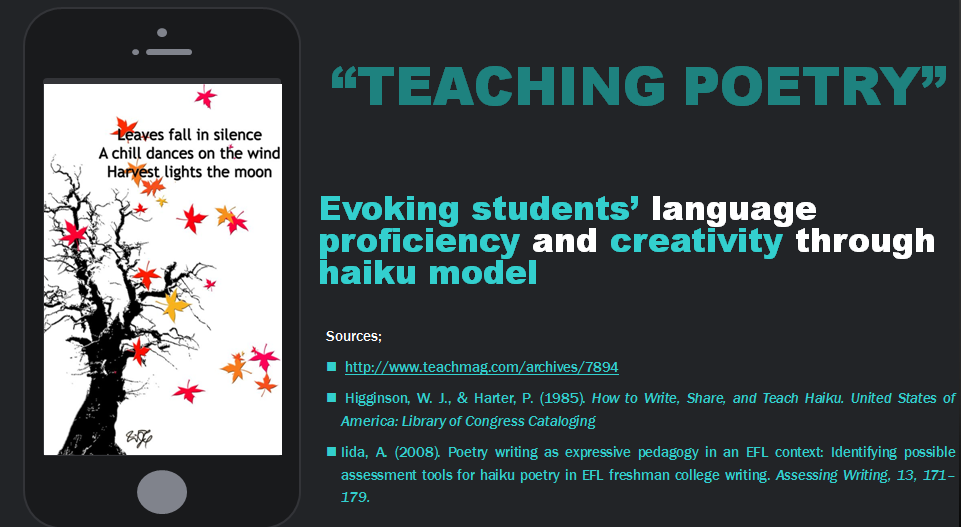
Innovative way of Teaching Poetry


READMORE
 

Multimodal Perspectives of University Students’ Language Attitudes towards Languages of Instruction in EFL Clasroom Discourse: Revealing Meaning through Integrated Semiotic Resources


This study is about Multimodal Discourse Analysis in an EFL (English Foreign Language) classroom involving both students and teacher discourse. Drawing from the perspective of multimodality, this study examines; how do students’ language attitudes and languages of instruction of the teacher integrated in classroom interaction. The writer’s interest is the interpretation of semiotic resources, including oral language, gestures, and visual products as meaning making within the classroom. The results will facilitate both researchers and educators in the future to examine the multimodal instructional design in terms of its effectiveness for EFL classroom.


A. Previous Researches Finding


Many researchers had reported the alternatives way to show students’ language attitudes and teaching instructional in EFL clasroom. Some of other aspects related to research findings that closely related to this study as follows;


a. Webster, Mavies, Timothy, and Cordial (2012) conducted study that was aimed to investigate influence of language attitudes of secondary school teachers and students on their choices as to whether Shona as language policy in Zimbabwe can be used as medium of instruction in secondary schools. The attitude of principal users and implementers of language change has been examined. Their finding showed that the majority of secondary school teachers and students prefer using English to Shona as medium of instruction. They finally assume that attitudes of users regarding the proposed language innovation, negatively affect the implementation of the proposed change. The similarity between Webster et al. (2012) study and the writer’s study is that; it involves both students language attitudes and teacher instructional language. The difference can be clearly seen at the method of collecting data. The data from Webster et al. (2012) research were collected and organized into graphs and tables which is the result of questionnaire for interpretation of teachers and students’ language attitude, and this study itself concern about Discourse Analysis in the perspectives of Multimodality where video data as a representation of the whole environment in classroom or the spatial arrangement of objects, which includes visual communication and the material combine with visual, written, spoken and gestural modes..


b. A thesis by Assefa (2002) investigated students' attitude towards Sidama language as a medium of instruction and its determination on the language achievement. By using questionnaires to measure their inclination towards the native language instruction, he suggests that teachers and educational practitioners should give due attention to attitude and motivation during instruction besides the cognitive factors. It is obvious that there is similarity of Assefa (2002) research to the writer’s research that both researches are under investigation of students’ attitudes toward the language of instruction but in in the writers’s study, it is more focussed on English and Indonesian alternately used as medium of instruction in classroom context. Multimodal interaction wil be analyzed in details.


In sum, this study is quite different with the others as mentioned above since none of the latter researchers have used Multimodal Discourse Analysis (MDA) as their primary approach. The writer hopes that the result of this study is expected to give new perception about students’ language attitudes and language of instruction used by teachers, principally in English Language Learning (ELL) process, and particularly in Indonesian area.


B. Review of Related Literature


Since the study specifically for multimodal perspective and simultaneously addresses several issues, including multimodality, educational context, students’ language attitude, language of instruction, and classroom discourse, the literature review is divided into two sections: Multimodal Discourse Analysis which covers researches point of view of several issues related to writer’s study, and Clasroom Discourse which covers students’ language attitude and teaching instructional.


1. Multimodal Discourse Analysis


Another area of Discourse Analysis that has commonly been approached is multimodal discourse analysis (Hencefort MDA). MDA is introduced by Gunther Kress and Theo van Leeuwen (1996, 2006) and Michael O’Toole (1994, 2010) who originally provided the foundations for multimodal research in the 1980s (O’Halloran, 2011). This research has expanded in mid-2000s onwards as systemic linguists and other language researchers became increasingly interested in exploring the integration of language with other resources. There was an explicit acknowledgement that communication is inherently multimodal and that literacy is not confined to language.


MDA procedures acknowledge meaning not only to written discourse, but also to visual images. Theorists such as Ferdinand Saussure believed that signs had a role in society and were part of social life. According to Saussure in Gonzalez (2011), a sign consisted of a signified (our concept and definition of the sign) and a signifier (the actual picture and its meaning).


Bower and Hedberg (2010) stated that Multimodal discourse analysis is an increasingly important technique for analyzing contemporary learning contexts because it attends to the multiplicity of modes of communication that may be active. In contrast to single channel discourse analysis techniques where one mode of communication is considered (as is the case with text-chat transcripts), multimodal discourse analysis allows all modes of communication to incorporate into an analysis. Where many channels of communication are being used, only analyzing a subset suffers the risk of leaving out much of what is being communicated which can potentially result in incomplete or inaccurate conclusions.


In short, Multimodal Discourse Analysis is where language and many modes (resources) are integrated to create meaning. From the perspective of a producer of the information, we can descibe the modes in form of Head movements in which information about feedback, acknowledging, agreeing, rejecting and turn-taking, Gaze which is information about attitudes like interest, Pupil size indicates increased or decreased interest, Lip, arms and hands movements, Posture which is about attitudes like shyness or aggression. Distance which indicate friendliness and "closeness". And the linguistics such as spoken and non-linguistic sounds about specific types of activity or about specific tasks within an activity.


a. The Nature of Meanings in Multimodality


Multimodal discourse analysis draws upon systemic functional linguistics to deconstruct the types of meaning that occur within the communications that transpire. Types of meaning including the three distinct ‘metafunctions’ which are consisted of; Ideational Meaning, ideas about the world involved Experiental and Logical Meaning, Interpersonal Meaning or enactment of social relations and Textual Meaning, organization of the meaning as coherent text and units (O’Halloran, 2011).


As resources, the interpersonal, ideational and textual elements form a system of meaning making that allow discourse to be formed through the discursive flow they enable. Modalities can represent all three types of meaning (Jewitt, 2008). For instance, in the visual mode ideational meaning is purveyed using narrative representations (that show the unfolding of actions, events, or processes of change) or conceptual representations (that relay the generalized, categorical and stable characteristics of elements). The visual mode can be used to deliver interpersonal meaning by depicting relationships between viewers. Finally, the placement of elements in a composition can affect the information value they have in the context, influencing the textual meaning (Jewitt, 2008). It is clear that, we employ many activities (modes) in the process of communication and interaction since we live socially.


In addition to the process of communication, specific means of the way humans communicate have been subdivided by expert (Allwood, 2002) in this area it consist of three means of communication;


1) Primary: Primary means of expression are means of communication that can be controlled directly without extra aids, e.g. bodily movements, voice, speech, gestures, touch, song, etc. Possibly production of molecules related to smell and taste could also be included. An argument against including smell and taste is that even though they are directly causally related to man, they are usually not controllable. Concerning the other primary means of expression, they include both spontaneous indexical and iconic means as well as symbolic means dependent on social conventions (speech, gestural language and certain types of song).


2) Secondary: Secondary means of expression simply consist of the instruments which are used to augment and support the primary means of expression. Secondary means are used, for example, to overcome spatial distance and to preserve information over time, e.g. using pen, chisel, typewriter, computer, megaphone, microphone with a loudspeaker, semaphore, radio, TV, audio and videotapes, telephone, telegraph, fax or e-mail. As we can see some secondary means directly reproduce primary means, e.g. radio, megaphones, audio tapes while others require more advanced recoding of primary means, e.g. writing. In some cases, this recoding requires several steps, e.g. telegraph or e-mail.


3) Tertiary: When we come to tertiary means it might be objected that the label "means of expression" is not entirely adequate. Tertiary means are simply all human artifacts (no negative evaluation intended) that are not secondary means of expression, e.g. tables, chairs, houses, roads, household appliances, cars, etc. All such artifacts express technical, functional and aesthetic ideas and intuitions. Perhaps the artifacts which are easiest to regard as means of expression are those which mainly have an aesthetic purpose like paintings and sculptures, etc. Second to these, there are artifacts, the construction and shaping of which has been under relatively direct causal control by the person who has made them. In most traditional cultures involving "handicraft", such control was usually individually exercised by both masters and apprentices. The artifacts in industrial societies, however, have less and less of such individual control and are instead often products of teamwork and industrial mass production. If they are to be seen as means of expression they must perhaps be seen as an expression of a collective rather than an individual mentality. In fact, this was perhaps also true of older traditions and artifacts where the creation of a single individual often was constrained by tradition and for this reason difficult to discover.


b. Research on Multimodality


Some researches about the use of multimodal semiotic resources in classrooms generally have been conducted (Kress et al., 2001; Hoban and Nielsen, 2012; Jaipal, 2010; Marquez et al., 2005; and Jewitt, 2008). These studies focus on how certain concepts are represented and communicated multimodality. For example, Kress and colleagues (Kress, Jewitt, Ogborn, & Tsatsarelis, 2001) examined how nonlinguistic modes, such as gestures, can fulfill ideational, interpersonal, and textual meta-functions in classrooms. Hoban and Nielsen (2012) explored pre-service teachers’ perceptions of using a slowmation technique to represent the science concept. They believed that slowmation provides potential of preservice teachers seek information, represent it using different modes and then use their own technology to combine them as a multimodal representation. In addition to Jaipal (2010) finding that teaching is a complex process, involving the use of multiple modalities. The multimodal semiotic analysis highlighted how different modalities scaffold each other to enhance meaning-making possibilities, and most importantly, it highlighted important features of semiotic modalities that should be taken into account by teachers during the meaning-making process. Marquez, Izquierdo, and Espinet (2005) study draws a more accurate picture of the role, speech, gesture, and visual language (through the use of diagrams and arrows) play in modeling the water cycle in secondary science classrooms. Based on this idea, the process of teaching and learning process is based on the semiotic resources because in the end it is difficult to create meaning in a single mode. Additionally Jewitt (2008) claimed that the most fundamental aspech which is called knowledge is represented as well as the mode and media chosen.


Following the trend in multimodality applied in clasroom, a small number of studies on multimodal teaching, learning, and assessment for ELLs has also been conducted in different content areas (Ajayi, 2012; Early & Marshall, 2008; and Pandya, 2012;). Ajayi (2009) studied on semiotics to argue that multimodal textbooks encode specific knowledge that offers teachers and learners new possibilites for design teaching and learning of English language. He claimed that ESL teachers were faced with problems on teaching English language learners how complex multimodal resources combine and integrate to design meaning in the textbooks they teach. In the same context but another researcher, Pandya (2012) tackles the complicated issues surrounding the assessment of English learners’ literacy skill development in the multimodal classroom. She contends to open Pandora’s box in order to prove links between multimodality and literacy skill development. Early and Marshall (2008) study explores how using a multimodal approach to integrating language and content teaching, high school students with limited English proficiency can be supported to engage in rich, complex interpretations of literary works in English and to realize their interpretations linguistically in written academic discourse. They suggest that a multimodal approach, in combination with cooperative group work and L1 use, has considerable potential in promoting ELL students’ academic success.


More recently, some studies began to link the multimodal representations into learning effectiveness (Zang, 2016 and Howell et al., 2015). For example, Zang (2016) studied about multimodal science discourse in sheltered classroom involving English Language Learners only, this ethnographic approach examined how the learning is constructed in science lecturers through multiple semiotic resources. Obviously Zang’s research is the closest one with the writers’ study. However the research tend to focus on how the incorporation of multiple modes enable teachers and students to represent the science content where the writer study try to explore broader aspect include the students’ language attitudes and teacher instructional aspect if we look at the multimodal perspective in a searching of relevant meaning. Howell, Reinking, and Kaminski (2015) propose the perspective of multiliteracies frames writing instruction as the creative construction of meaning across various modalities, and they illustrate how that view might be instantiated instructionally by engaging students in the creative design of multimodal arguments.


It should be noted that multimodal discourse analysis is a developing field and that while some excellent qualitative research has been performed in this area (Kress et al., 2001; Jewitt, 2006; Jaipal, 2010; Hoban and Nielsen, 2012; Ajayi, 2012; Zang, 2016). This study extends and adapts previous approaches to conduct a large scale qualitative analysis of teaching and learning in an EFL environment in relation with students attitude and teacher instructional.


2. Classroom Discourse (Multimodality)


In this section, the writer only focus on variety of modes in range of educational contex. The are a number of semiotic modes available to practice the students and teacher. Educational context is the most suitable place and at the same time provoke many elements to create meaning in order to fulfill our learning needs. Furthermore English as a special subject in that students and teachers have to understand and be able to switch between a number of different representations of the same phenomenon. The students and teacher may immerse with a variety of modes including aural (e.g., music) visual (e.g., pictures, art), aural/visual (e.g., television, video games), linguistic (e.g., storytelling), gestural (e.g., body control, emotion), and spatial (e.g., geographical, architectural) modes (L, Linebarger, & Norton-Meier, 2016). They subsequently use these modes to make sense of their worlds. For instance, very young children will frequently draw pictures that reflect their mental representations about various objects, events, or persons


However, as Hammond (2011) point out in their introduction to Discourse and Education (volume 3 of Encyclopedia of Language and Education), in current literature, classroom discourse refers both to ‘talk-in interaction’ in classrooms, and to the critical post structural view of discourse as ‘ways of understanding and constituting the social world’. The writer emphasis is primarily on any meaning aspect of language both students and teacher influenced by semiotic resources in process.


Below there will be explanations about the students language attitudes and language of instruction.


a. Students’ language attitudes


One of the issues that have attracted the attention of scholars regarding language learning is the issue of students’ language attitude. Attitude is considered as an essential factor influencing the students language performance. Students’ language attitude is one of the main factors that determine their success in language learning. There was a strong correlation between the students’ attitudes toward learning language and their performance in their linguistic skill. Attitude has cognitive, affective and conative components; it involves beliefs, emotional reactions and behavioral tendencies related to the object of the attitudes.


Attitudes is strictly related to cognitive dimension, According to Ecless and Wigfield (2002) students’ attitudes influence their willingness to en­gage in tasks from the teacher.


Some researchers (Eshginejad, 2016; Momani, 2009; and Mitchell and Myles in Yang Yu, 2010) have conducted on the role of students’ attitudes in language learning and indicated that they have positive attitudes toward learning English (Momani, 2009). However, qualitatively we need to point our view into more broader look, it means rather than looking the one-sided perspective, the writer tends to look at both side between positive and negative perspective of the students’ language attitude. As Mitchell and Myles in the dissertation of Yang Yu (2010) that attitudes towards the target language, its speakers and the learning context may all play some part in explaining their success or failure, based on this idea, we can claim that there is positve attitudes and negative attitudes playing essential role and better teaching strategies, classroom management and good social environment can help reduce negative attitudes.


There are many reasons why this study concerns more about students’ language attitude rather than other mainstream aspects. First, it takes an essential part of the succesfull in the language learning process, second the attitude is not as simple as it exists as intellectual capacity, such as the students willingness of selecting their best prepared material or reading matter to support learning but more into their action such as speaking in certain language. It sounds logical when they can show their spoken performance in the end of the class since they deal with language learning. However another research found that language learning should be approached primarily as a social and psychological phenomenon rather than as a purely academic one (Eshghinejad, 2016). Furthermore given from another perspective, language learning should balance those components.


The studies on attitudes of learners in language research have explored a number of settings due to the complex nature of attitude and the breadth of its impact on various fields of language learning. In line with this, the methodology used in studying language attitudes is varying. We may found the majority of research data on people’s attitudes gathered using questionnaire like Likert-scale but other methods may be useful in order to give a broader perspective of students’ attitude.


Having regard to the multimodality, attitudes may also in form of discourse, as it express passions and hates, attractions and repulsions, likes and dislikes and represent one’s idea (Gilbert, Fiske, & Lindzey, 1998), there will be something to make them all real for instance it is observable since vision is very powerful that amounts of information can be presented visually at any time. Both gesture and language are the easiest way to describe attitudes (behavioural intentional attitudes). However attitude in this context is considered as the students’ language attitude toward the triger. Many multiple modes may be appear in the process of whether gaining gain nuanced understanding of subject-matter, powerfully express what they learned, and discover a psychological refuge.


The challenges of ELLs in clasroom discourse appears on the surface where it involves communication process., relating to the students’ language attitude, they often create unrecognizable kind of modes. The teacher spend a lot of time looking up or guessing meanings of students which might result in regressive eye movement or gaze, body language and gesture and eventually creating spoken language. However the meanings made are not always able to be understood. Furthermore by the works of multimodality we are able to see how meaning is constructed through this multimodality


b. Language of Instruction


Due to widespread use of English as medium of instruction and object of learning. Some contries decide to use English as their primary language of instruction. Many researcher also become interested to investigate this phenomena since naturally some of them do not live with English as their national language. In addition this aspect, Indonesia as on of them, there is no clear mandate concerning the language to be used in the classroom.


In Indonesia, the sole medium of instruction is Indonesian, except in the first three grades of elementary school in areas where the learners do not know enough Indonesian for classroom interaction. In the usual situation, the local vernacular can be used as a transitional medium of instruction to ease the learners into the use of Indonesian as a medium of instruction and classroom interaction. The curriculum also has changed from time to time, many books especially in English are all written in English but the main spoken laguages are still the national language or Bahasa Indonesia in many secondary downward. However, this circumstances may change when many unversities tend to use English as their language of instruction in their courses, but still this is just an individual willing.


Given the possibilites of multimodal applied in pedagogy area, many scholars (Kajee, 2011; ) have evaluated language of instruction from various aspect. The most important key aspect of the studies are as folows;


Kajee (2011) explores the multimodal engagement of English as an additional-language (EAL) students in a classroom in Johannesburg. Within a social semiotic framework, and using constructions of design and identity to understand the students’ multimodal engagement, the paper argues that multimodal representations offer EAL students from under-resourced contexts opportunities for creativity and agency to redesign meaning. It demonstrates how they use the opportunities provided to reconstruct their identities as black South Africans and to communicate a sense of their own social world. The analysis focuses on two texts produced by the students, a digital narrative text and a poetry performance to illustrate their multimodal engagement with literacy. The paper concludes with an examination of the broader implications for teaching and learning EAL.


Having regard to the teachers’ role and multimodality, while conveying the their instructions, the teacher are usually supported by other modes, it can be by in form of disambodied mode for example, batons, or may be in form of embodied modes which consisted of eyebrow raising, high intensity or pitch of a tonic vowel. Another specific modes while teacher neeed to list something (e.g. first, second third and so fort) they may perform gestural modes like counting on finger, or marking all the items in the list with the same intonational contour; topic shift may be expressed through posture shift. Furthermore, the way of teachers convey their language instructional not only inclined to be influenced by one single mode (spoken discourse) but many semiotic resources in process, including gestures, emotional intonation, facial expression, gaze and posture.


A teacher in classroom interaction conveys all of these meanings; but some are conveyed more frequently, because of the teacher’s particular role. Starting from the taxonomy above, then, we can predict the specific communicative profile of a teacher’s communication. Of course these predictions stem from our stereotype of the teacher’s role, but they can be tested on real data.


A great part of the teacher’s classroom communication informs about the contents of different disciplines that include both concrete and abstract information. In some cases, concrete information like the shape of an object or a space, or a sequence of actions is better conveyed by iconic signals, like pictures, paintings, pantomime or iconic gestures. But gestures have proved to be useful also in the explanation of abstract (for example, mathematical) concepts [8].


3.2 Information on the Speaker’s Mind. This is the realm in which teacher’s multimodal communication is most informative.


Beliefs. Starting from information on the Speaker’s beliefs, namely the degree of certainty of the beliefs she mentions (a.1.), we predict a teacher will not convey uncertainty or doubt so often, given the image of a self-confident person she must generally project in front of her pupils. So, her most frequent expression will be the small frown showing that she is serious in what she says, and that she believes it strongly. As to the metacognitive information about the source of her current knowledge (a.2.), during a lecture the teacher will rarely gaze side-downward, or raise eyes up, because she is usually supposed to remember the things she reports very well, without needing to retrieve them from long-term memory, or to reason long about them.


Goals. The teacher’s communication (as opposed to the layperson’s) is supposedly particularly rich in providing information about her sentence, discourse and conversational goals. As shown by studies on teachers’ behaviour [1], the teacher’s performatives, i.e. the specific communicative intentions of her sentences, are a great number: question, peremptory order, advice, approval, praise, blame, reproach, question with an indirect meaning of command, praise with an ironic meaning of blame; but they are rarely conveyed by the classical performative verbs (I order, I advice, I propose... [18], [19]); they are generally expressed by intonation, gaze or facial expression. Instead of saying “I order you to turn off you cellular”, the teacher will express the propositional content of the speech act (“Turn off your cellular”) while conveying its performative by a severe directive intonation, and/or by a serious ace, no smile, head up, gaze staring at he pupil. Performative intonation and performative facial expression [20] are sophisticated devices of human communication, devoted to convey even the most subtle nuances that distinguish performatives from one another. This is why the teacher’s voice and face behavior are important in educational interaction. One more frequent and important information the teacher conveys, but mostly not by verbal language, is about the relative importance of the different parts of a sentence of discourse: the topic-comment distinction. More than in everyday communication, the teacher needs to distinguish, within her sentence or discourse, the beliefs that pupils have to retrieve from their long-term memory (topic) from the new beliefs to connect with them that are the object of the teacher’s present communication (comment). Often, to explain new concepts that to be understood require reference to previous contents, the teacher has to recall a lecture or an activity performed even months before. This distinction between what is to be retrieved from memory and what is coming as new is generally expressed by facial and intonational devices [10].


Again, gesture and intonation are of help when the teacher makes explicit the rhetorical relationships among different parts of the discourse she is delivering. An aid to understand and memorise a discourse is to know the Author’s outline. This is why a teacher often says: “I’ll now speak of X… now I come to topic Y…”. But this can also be done in nonverbal ways: a posture shift, for instance, signals we are moving to another topic or starting a digression [21]. Another way to stress transition to another sub-topic is counting paragraphs, not only verbally (“first… second…. third…”) but also gesturally, by counting on fingers. Intonation has an important role too: a recurrent intonational contour signals we are listing different items of the same class, while we can mark a parenthetic clause through lower pitch and intensity [22]. The signals to regulate turn-taking and to provide back-channel are particularly important in classroom interaction, both for teacher and pupils; and the teacher must be particularly aware of these signals, whether delivered from herself or the pupils. A trivial example is when a pupil raises a hand to ask for a speaking turn. But while this holds in a classroom with a quite asymmetrical structure and rigid interactional norms, it could not hold in a democratic group or while working in a small team. In this case, a teacher that wants all members to talk must be aware of more subtle ways of asking for a speaking turn: leaning forward, opening mouth as in starting to speak, opening eyes wider. Finally, a back-channel signal is any communicative verbal or nonverbal act performed by an Interlocutor to provide a feed-back to the present Speaker about whether the Interlocutor is a. understanding, b. believing, c. approving, and d. finding interesting what the Speaker is saying. I can say “I see” or simply nod to tell you I understand what you are saying; if I don’t understand I’ll say “I can’t follow you” or frown; if I understand but I don’t believe it, I can say “I don’t believe it”, shake my head or show a facial expression of doubt or perplexity; I can nod also for approving, and shake head, shake index finger, or frown for disapproving; if what you say is very interesting I’ll say “You don’t say!”, or “Oh!” emphatically, or raise eyebrows to show surprise; but if I am not very much concerned or definitely bored, I can cyclically repeat “oh”, with a very flat intonation, or even yawn. Now, some back-channel signals may be emotionally loaded, since they imply an evaluation and then may touch or hurt the Speaker’s image or self-image: letting the speaker know that I don’t believe what she says, or that her talk is boring, may be offensive. So we can predict 1. what back-channel signals are more frequently provided by teachers and pupils, respectively, and 2. what back-channel signals are more relevant for, respectively, teachers’ and pupils’ behaviour. A very young pupil will not perform many back-channel signals of incredulity, not only because it is implausible for him to have a knowledge base sufficiently larger than the teacher’s enabling him to know things contrasting with what she says; but also because, even if the pupil really does not believe the teacher, he might be afraid to offend her by showing it. Again, a pupil will be particularly sensitive to back-channel signals of approval and disapproval. Conversely, if a teacher thinks motivation is an important basis for learning, she will pay attention to signals of interest or boredom.


Emotions. As to information about emotions, a teacher may feel various kinds of emotions during class work: joy, stress, anxiety, enthusiasm; tenderness, compassion, love, hatred, worry, anger, interest, curiosity, boredom. Of course, the very fact that a teacher expresses her emotions may be subject to sanction; so some teachers may claim they do not express their emotions to pupils, but yet their emotions can leak out from nonverbal behavior: anxiety or anger may be not expressed by a specific signal, but by some aspects of how one performs verbal or nonverbal signals: some subparameters of gestural or bodily behaviour like rhythm or muscular tension may vary producing a particular muscular tension in making gestures, a higher pitch of voice in speaking, a higher speed in moving around in the classroom.

The first thing we need to consider as teachers and researchers is how to rethink our current focus on transmission. In addition, we need to review how we assess achievement and progress if we are to harness what our students bring to the classroom in the form of their own meanings, through the use of image, gesture, dress, technology and so on. As teachers we do not seem to have a sufficiently strong semiotic sense, a capacity which is often inadequately promoted teacher training.


Multimodality, through a paradigm of social semiotics, has the potential to transform the teaching and learning by providing students with new opportunities for agency and voice. The multimodal environment facilitates the emergence of shared moments of learner participation, negotiation and renegotiation of meaning within the classroom as a community of practice.


BIBLIOGRAPHY


Allwood, J. (2002). Bodily Communication Dimensions of Expression and Content. In B. Granstrom, D. House & I. Karlsson (Eds.), Multimodality in Language and Speech Systems. Goteborg, Sweden: Springer Science and Business Media, B.V.


Assefa, A. (2002). Students' Attitude Towards Mother Tongue Instruction As o Correlate of Academic Achievement: The Case of Sidama Adamu Assefa (Master of Arts), Addis Ababa University.


Bower, M., & Hedberg, J. G. (2010). A quantitative multimodal discourse analysis of teaching and learning in a web-conferencing environment – The efficacy of student-centred learning designs. Computers & Education, 54, 462–478.


Early, M., & Marshall, S. (2008). Adolescent ESL Students’ Interpretation and Appreciation of Literary Texts: A Case Study of Multimodality. The Canadian Modern Language Review, 64(3), 377–397.


Ecless, J. S., & Wigfield, A. (2002). Motivational, Beliefs, Values and Goals. Annual Review of Psychology, 53, 109-132.


Eshghinejad, S. (2016). EFL students’ attitudes toward learning English language: The case study of Kashan University students. Cogent Education, 3.


Gilbert, D. T., Fiske, & Lindzey, G. (1998). The Handbook of Social Psychology (4 ed. Vol. 1). Boston: The McGraw-Hill.


Gonzalez, E. F. (2011). An analysis of a Mexican EFL textbook: A written discourse perspective. University of Birmingham. Birmingham.


Hammond, J. (2011). Classroom Discourse. In K. Hyland & B. Paltridge (Eds.), The Continuum Companion to Discourse Analysis. London: Continuum International Publishing Group.


Hoban, G., & Nielsen, W. (2012). Using “Slowmation” to Enable Preservice Primary Teachers to Create Multimodal Representations of Science Concepts. Springer Science, 42, 1101–1119.


Howell, E., Reinking, D., & Kaminski, R. (2015). Writing as Creative Design: Constructing Multimodal Arguments in a Multiliteracies Framework. Journal of Literacy and Technology, 16(1).


Jaipal, K. (2010). Meaning Making Through Multiple Modalities in a Biology Classroom: A Multimodal Semiotics Discourse Analysis. Wiley Periodicals, 94(48).


Jewitt, C. (2008). Multimodality and Literacy in School Classrooms. American Educational Research Association, 32, 241-267.


Kajee, L. (2011). Multimodal representations of identity in the English-as-anadditional-language classroom in South Africa. Language and Culture Curriculum, 24(3), 241–252.


Kress, G., Jewitt, C., Ogborn, J., & Tsatsarelis, C. (2001). Multimodal teaching and learning The rhetorics of the science classroom. London and New York: Continuum.


L, D., Linebarger, & Norton-Meier, L. (2016). Scientific Concepts, Multiple Modalities, and Young Children. In B. Hand, M. McDermott & V. Prain (Eds.), Using Multimodal Representations to Support Learning in the Science Classroom. New York and London: Springer International Publishing.


Marquez, C., Izquierdo, M., & Espinet, M. (2005). Multimodal Science Teachers’ Discourse in Modeling the Water Cycle. Wiley Periodicals.


Momani, M. (2009). The Jordanian secondary stage students achievement in reading comprehension according to their views towards learning English as a foreign language. Journal of Human Sciences,, 42, 1–36.


O’Halloran, K. L. (2011). Multimodal Discourse Analysis. In K. Hyland & B. Paltridge (Eds.), The Continuum Companion to Discourse Analysis. London: Continuum International Publishing Group.


Pandya, J. Z. (2012). Unpacking Pandora’s Box Issues in the Assessment of English Learners’ Literacy Skill Development In Multimodal Classrooms. Journal of Adolescent & Adult Literacy, 56(3), 181–185.


Webster, K., Mavies, K., Timothy, B., & Cordial, B. (2012). The influence of teachers and students’ language attitudes towards the use of shona as medium of instruction in secondary schools. International Journal of English and Literature, 3(2), 32-39.


Yang Yu. (2010). Attitudes of Learners Toward English: A Case of Chinese College Students. (Post Graduate Program in Education), The Ohio State University, Ohio State University.


Zang, Y. (2016). Multimodal Teacher Input and Science Learning in a Middle School Sheltered Classroom. Journal of Research in Science Teaching, 53(1), 7–30.


READMORE