Tampilkan postingan dengan label Trik Dan Tips. Tampilkan semua postingan

Flower & Frame


Pernah aku mengalami kehidupan layaknya kayu usang, tanpa cahaya, terbaring lapuk. Saat itu sangatlah buruk, aku tidak mengatakan semua kehidupanku buruk, namun kala itu benar-benar buruk, dan yang membuatku merasa sangat buruk adalah kenyataan dimana aku sama sekali tidak berfikir bahwa aku menjalani hidup dengan amat buruk.

Terlalu banyak berfikir kadang menjadi senjata yang menakutkan, tiap kata yang teruntai dari seseorang entah mengapa selalu beriringan dengan anggapan negatif, tiap tindakan yang mengarah kepadaku selalu saja menggangguku. Aku memang kurang pandai membaca situasi hingga logika yang keliru menjadi tameng utamaku. Sepenuhnya aku hampir tidak percaya akan anggapan bahwa kebaikan akan datang. Aku sepenuhnya adalah sosok yang dingin dan penuh dengan kegelapan.

Sepenuhnya adalah kegelapan. Apalah arti hidupku ini jika secercah cahaya sedikitpun tidak datang menghampiriku. Selalu terbesit dipikiranku untuk segera mengakhiri ini.

Dulu, aku memang tidak menemukan cahaya karena telah tertutup gelap, aku sangat beruntung karena jika tidak demikian aku mungkin tidak merasa sebahagia sekarang ini ketika menemukan harapan kala cahaya kecil kian mendekat.

“Bayangan yang sama sekali tidak terpikirkan oleh ku, _setangkai bunga yang teramat indah.”

Yah. Aku yang sekarang merasa bingung. Dia yang menemukanku untuk mengubahku atau aku yang menemukannya untuk terus bersamanya. Selama ini yang aku tahu takdir hanya memutarbalikkan keadaan seenaknya saja. Hal yang seindah ini bahkan takdir pun seolah tidak cukup untuk membuat nya ada. Aku akhirnya dihadapkan dengan dua jalan yang berbeda, dan memaksaku berfikir apakah nasibku akan berubah dengan memilih mengikuti bayangan bunga ini atau justru menghiraukannya begitu saja.

Sungguh bodohnya aku. Mengapa disaat seperti ini logika menuntunku mulus. Dengan sepenuh hati tentu akan terus mengikuti bayangan bunga itu. Dahulu definisiku tentang menjadi hidup tidak tidak perlu ditanyakan lagi, mana mungkin sosok yang pertama kali muncul dan menuntunku menjadi lebih menghargai hidup aku hiraukan begitu saja. Namun dia adalah bunga, dan karena ia adalah bunga, saat itu juga aku berhenti untuk berharap lebih. Mengatakan “aku menyukai keindahanmu, keelokan dan kecantikanmu” tentu akan meredupkan pernyataan tulus “aku menyukaimu apa adanya”.

Bingkai dan Bunga, mungkin itulah perumpamaan yang tepat untukku dan untuknya. Aku berada dalam situasi dimana untuk mendapatkan kebahagiaannya saja tidak pantas. Bagiku membuatnya terus bahagia sudah cukup. Tugasku, lebih tepatnya kehadiranku hanya untuk menampilkan keindahannya. Aku tak akan membiarkan sedikitpun dari keindahan kelopaknya terbang sia-sia. Terus membuatnya bermekaran adalah impianku. Membiarkannya layu merupakan penyesalan terburukku.

Aku sama sekali tidak peduli apa kata orang. Kepedulianku terhadap diriku sendiri sudah lama memudar. Sekarang untuk menebus semuanya, akan kuberikan kepedulian ku padanya tanpa sedikitpun mengharapkan balasan. Bagiku keputusan terbaik yang aku lakukan adalah “saat ini”. Mendukung dari balik layar sungguh tidaklah seburuk yang aku duga. Menjadi bingkai untuknya, membuat keberadaanku lebih berarti mengingat sebelumnya aku yang diterima olehnya pun tidak layak. Dari awal memang aku tidak menuntut apapun dan sampai kapanpun akan terus seperti itu.

“Jangan pernah memikirkan bingkai ini, teruslah bermekaran dengan kelopak indahmu.”
READMORE
 

Discourse Analysis on Students' Joke


EXAMINING TEXTUAL JOKES AMONG STUDENTS TENSION TOWARD ACADEMIC ASSIGNMENTS
Ikrar
ikrarki@yahoo.com
English Educational Department Graduate Program of State University of Makassar, Indonesia

ABSTRACT
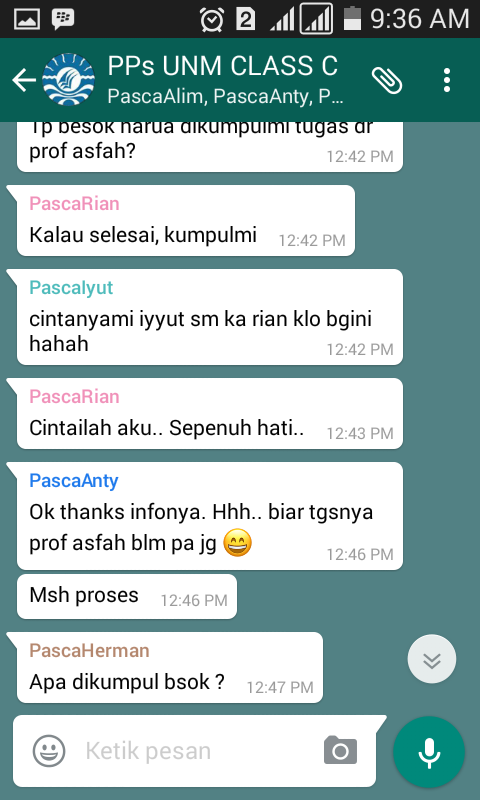
Jokes has an essential resource that can be used to transmit concepts, motivate students, encourage creativity especially when dealing with a lot of academic assignments. Therefore it is important to examine the types of jokes used by students in WhatsApp chat. The other focus of this research is to explore the supplementaries of joke used by humorous students in order to assuage students‟ tension toward academic assignments. This paper is based on a research conducted in 2017 at English Graduate Program of State University of Makassar, South Sulawesi, Indonesia. This research only concentrated on Class C of classroom discussion about their assignments. Through WhatsApp, students expressed their utterances into textual messages, emoticons, phonetic spelling to create verbal effect and eventually creating laughter in process. In this research all the students messages is taken from WhatsApp chat and examined to check the underlying types and also the supporting devices of their jokes. The results show that English students use seven types of jokes (Görlach, 2004) with six supplementaries of jokes (Ritchie, 2004). Findings in this research are relevant in the development of English language learning particularly in attempt to create motivation among their tension.

Keywords: types of jokes; jokes supplementary; whatsapp chat; academic assignments; students‟ tension; English courses

Full text: here
READMORE
 

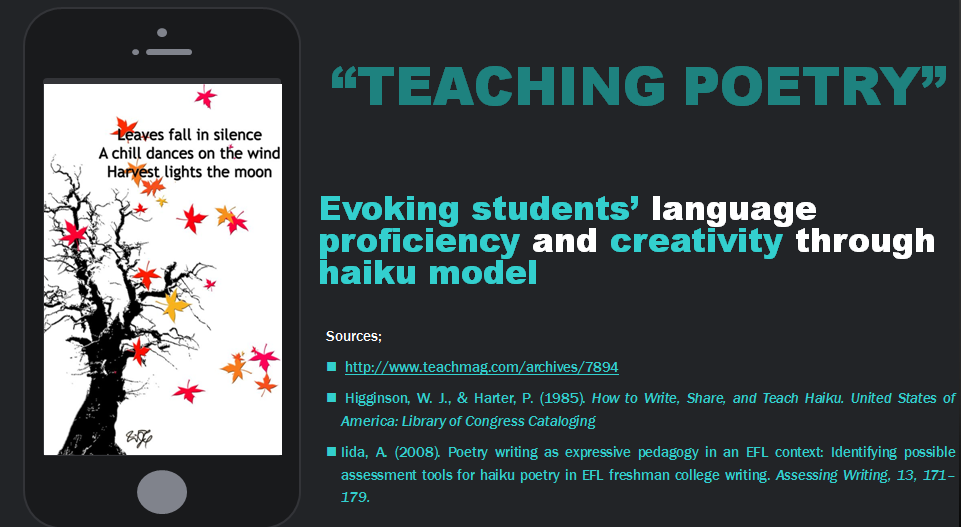
Innovative way of Teaching Poetry


READMORE
 

Stylistics in the classroom (Summary of Gillian Lazar book)

 Stylistics or stilistika in Bahasa concerned with aesthetic aspect of a language and also social background. In the clasroom, stylistic analysis has two main objectives: to enable students to make meaningful interpretations of the text itself; and to expand students' knowledge and awareness of the language in general. Thus, although the aim of using stylistics is to help students to read and study literature more competently, it also provides them with excellent language practice.

In order to drill our skill about this stylistics, I want all of us to recall the literary devices that we already learnt in the course previously, there is methaphor (A metaphor refers to a meaning or identity ascribed to one subject by way of another), simile (referring to the practice of drawing parallels or comparisons between two unrelated and dissimilar things, people, beings, places and concepts), assonance (repetision of vowels/ a long song), aliteration (repetion of consonants e.g : The Wicked Witch of the West went her own way. (The ‘W’ sound is highlighted and repeated throughout the sentence.), repetition of word or phrase, anagram for example an anagram for "debit card" is "bad credit". both phrases use the same letters. By mixing the letters a bit of humor is created. Analogy, a relationship based on similarities between two concepts or ideas. Puns (Definition: Puns are a very popular literary device wherein a word is used in a manner to suggest two or more possible meanings. This is generally done to the effect of creating humor or irony or wryness) e.g Santa’s helpers are known as subordinate Clauses.

So after we recognized the literary devices, there are activities both for the students and teacher as well.

A. Teacher

As we already know that we are usually dealing with text and we may analyze the literary text for any unusual or noticeable linguistic features. But before that, there is one possible procedure which involves two main steps:

1. Note down any linguistic features which are particularly noticeable. It is noticeable because they deviate slightly from what might be considered more grammatically or lexically usual.

2. Develop a series of questions which alert students to these features, and encourage students to reach an interpretation or appreciation of the text bearing these features in mind.

Example of literary text to analyze; (opening paragraph of V.S Naipaul’s novel “a House for Mr Biswas”)


B. Students

Here are some questions for students based on the text above that are probably relevant for secondary level;

Go through the questions yourself and note your answers.

1. Write down all the examples you can find in the text of exact numbers, figures or other precise details describing Mr Biswas and his situation. What effect do you think is created by using all these details?

2. In the opening lines of the text we are told that Mr Biswas was sacked. The author could also have said:' Mr Biswas was dismissed.' 'Mr Biswas lost his job.'

How would the use of these phrases in the passage have changed its meaning?

3. In what situation is it common to use the phrase 'I/We have no choice'? Do you think the newspaper had no choice in sacking Mr Biswas? What is the effect of using the phrase here?

4. In the second paragraph two phrases are repeated. Which ones are they? What do you think is the effect of repeating them?

5. In the second paragraph we have the phrase ' . . . Mr Biswas had been owing for four years . . . ' What tense is used here? It is probably more grammatically correct to use the phrase 'he had owed' (past perfect) since verbs of possession such as owe, belong, etc. are not usually used in the continuous form. What is the effect of using this tense here?

6. What feelings do you have for Mr Biswas after reading these two paragraphs? Why do you think this is so?

Stylistic analysis can also provide a way of comparing different types of texts (whether literary or non-literary) in order to ascertain how they fulfill different social functions. For example, students may be asked to compare the description of a character in a novel with the information about someone given in a letter of reference or on a medical form (Widdowson, 1975, Chapter 6). The students will then be able to examine how these texts differ and the reason for this difference. The teaching of literature can thus be integrated more fully into the classroom, since literary texts can be studied alongside other kinds of texts.
READMORE
 

Pengembangan Afektif (Cooperation) pada Teori Piaget

Menurut Piaget, anak pada usia 7 tahun akan memasuki tahap operasional konkret, dimana anak sudah mampu berpikir rasional, seperti penalaran untuk menyelesaikan suatu masalah yang konkret (aktual). Namun, bagaimanapun juga dalam kemampuan berpikir mereka masih terbatas pada situasi nyata. Pada bagian dibawah ini lebih pada pengembangan afektif dalam lingkup interaksi anak atau kerjasama.

Perkembangan kognitif dan Perkembangan afektif tidak dapat dipisahkan. Jadi, ketika perkembangan kognitif dan perkembangan afektif dikonsep secara independen, tidak dapat dipungkiri bahwa diantara keduanya terdapat kesejajaran yang jelas. Pada tahap operasional konkrit, penalaran dan pikiran memperoleh stabilitas yang lebih besar dari pikiran praoperasional. Kemampuan penalaran menjadi semakin logis dan kurang tunduk pada pengaruh oleh kontradiksi persepsi. Reversibilitas pikiran (kemampuan mengubah arah berfikir kembali ke titik awal) dan bantuan de-centering (anak mulai mempertimbangkan beberapa aspek dari suatu permasalahan untuk bisa memecahkannya) membawa konsistensi dan konservasi (kemampuan pemikiran logis) pada penalaran operasional konkrit anak.

Faktor-faktor ini mempengaruhi tidak hanya penalaran kognitif tetapi juga penalaran afektif. Selama tahap operasional konkrit, afeksi memperoleh ukuran stabilitas dan konsistensi yang tidak hadir sebelumnya.

Selama tahap operasi konkrit, reversibilitas muncul dalam penalaran afektif anak. Asal-usul reversibilitas dalam lingkup afektif tampak dalam tahap praoperasional. Pada saat itu, perasaan tidak sepenuhnya "di konservasi", dan afeksi bersifat prenormative; tetapi karena perasaan sehari-hari bisa diwakili dan di ingat, perasaan tidak lagi berhubungan.

Pada usia sekitar 7 atau 8 tahun, muncul konservasi perasaan dan nilai-nilai. Anak-anak menjadi mampu menyelaraskan pikiran afektif mereka dari satu peristiwa ke yang lain. Apa yang dilestarikan atau dipertahankan, dari waktu ke waktu, adalah beberapa aspek dari perasaan masa lalu. Pemikiran afektif sekarang dapat dibalik (reversible). Masa lalu bisa dijadikan sebagai bagian dari penalaran saat ini melalui kemampuan untuk membalikkan dan melestarikan. Contoh konkritnya, menambah dan mengurang merupakan operasi yang sama dilakukan dengan arah yang berlawan, 2+1=3, 3-1=2.

Piaget menyarankan bahwa interaksi sosial selama tahap praoperasional mendorong pengembangan konservasi perasaan.

....... kehidupan sosial memerlukan pemikiran untuk memperoleh hasil tertentu. Untuk dapat terjadi, aktivitas mental tidak lagi dapat diwakili dalam hal simbol khusus seperti fantasi yang lucu (simbol permainan) akan tetapi harus dinyatakan dalam penanda universal seperti tanda linguistik (bahasa). Keseragaman dan konsistensi ekspresi yang diberlakukan oleh kehidupan sosial memegang peranan besar, oleh karena itu, dalam pengembangan struktur intelektual dengan konservasi dan invarian; hal itu akan menyebabkan transformasi analog (perubahan yang sama) dalam domain perasaan. Akibatnya, performansi (hasil) jelas kurang dari perasaan spontan yang akan muncul dengan sosial dan terutama, perasaan moral .....

Menyukai orang lain adalah perasaan yang bervariasi selama itu spontan dan terkait dengan situasi tertentu. Hal ini menjadi langgeng dan dapat diandalkan ketika perasaan semi-kewajiban ditambahkan.

Dalam bab terakhir afeksi praoperasional adalah prenormative. Meskipun tidak sepenuhnya memenuhi salah satu dari tiga kriteria untuk menjadi normatif: (1) dapat di generalisasi, (2) yang bertahan, dan (3) yang terkait dengan otonomi. Selama tahap operasional konkrit, kriteria ini terpenuhi sebagai kemampuan penalaran afektif anak-anak menjadi "operasional." Dengan cara yang sama bahwa reversibilitas mengarah ke logika penalaran, yang mengarah ke logika afektif. Operasi yang dapat dibalik muncul dalam domain afektif.

Untuk lebih memahami keyakinan Piaget tentang perkembangan afektif selama tahap operasional konkret, penting untuk memahami konsepnya tentang kehendak dan otonomi.

Kehendak (Keinginan)

Piaget menegaskan bahwa "analog afektif operasi intelektual ditemukan dalam tindakan “kehendak". Dia melihat kehendak sebagai skala permanen dari nilai yang dibangun oleh individu dimana ia merasa berkewajiban untuk mematuhinya. Kehendak mengasumsikan peran sebagai pembuat aturan (self-regulation) dari afektif dan dengan mekanisme nilai yang dikonservasi. Dalam kegiatan kognitif, konflik antara pengalaman persepsi dan penalaran logis diatur melalui konservasi, kemampuan untuk mempertahankan kepatuhan dalam menghadapi perubahan secara logis yang tidak relevan. Demikian pula, konflik antara impuls afektif diatur oleh kehendak selama kehendak itu berada di tempatnya, nilai-nilai dapat dinyatakan pada dorongan yang bertentangan, meskipun dorongan mungkin lebih kuat pada satu titik dari nilai dan kehendak.

Menurut Piaget, terdapat sejumlah faktor pendorong terhadap pengembangan secara bertahap dari kehendak. Salah satu faktor, yang telah disebutkan, adalah tuntutan dari pengalaman sosial, yang mendorong konsistensi dalam jiwa afektif. Perilaku yang memiliki kesinambungan diperkuat oleh orang lain lebih dari perilaku yang tidak konsisten. Selain itu, pengalaman afektif dan perasaan sekarang dilestarikan. Pada saat saat tertentu, bekas-bekas afektif, diwakili dalam memori dan saaat ini, merupakan bagian dari penalaran afektif. Pengalaman afektif dari masa lalu tidak bisa lagi diabaikan. Kesadaran akan perasaan masa lalu dan sekarang dapat menyebabkan keputusan afektif yang berbeda dari kesadaran perasaan saat ini.

Otonomi (kemampuan untuk membuat keputusan sendiri

Otonomi berarti yang diatur oleh diri sendiri, bukan oleh orang lain (Kamii 1982). penalaran Otonomi adalah penalaran sesuai dengan set yang dibangun sendiri dari norma-norma. Lebih bersifat Mengevaluasi ketimbang otomatis menerima nilai-nilai yang dilakukan orang lain. Selain itu, penalaran otonom menganggap orang lain serta diri/ seperti dirinya sendiri (as the self).

Selama tahap praoperasional, anak-anak melihat dan menerima aturan yang diturunkan dari beberapa otoritas yang lebih tinggi seperti orang tua, Tuhan, dan otoritas tinggi lainnya. Keadilan dipandang hidup dengan aturan-aturan tersebut. Moralitas anak di tingkat praoperasional adalah salah satu ketaatan. Anak-anak praoperasional tidak memikirkan tentang apa yang benar atau salah. Bagi mereka, apa yang benar atau salah adalah yang telah ditentukan (otoritas) dan tidak tunduk pada penilaian mereka sendiri. Sangat sedikit interaksi kerjasama, dan yang mendominasi hanyalah ketaatan.

Sekitar usia 7 atau 8, anak-anak mulai mampu membuat evaluasi moral mereka sendiri. Artinya, mereka mulai memikirkan tentang "kebenaran" atau "ketidaktepatan" tindakan dan efek dari tindakan pada orang lain. Ini, tentu saja, tidak berarti bahwa pemikiran mereka tentu benar; itu berarti bahwa mereka mulai berubah dari moralitas ketaatan kepada nilai-nilai yang baru dibangun untuk moralitas kerjasama dan evaluasi.

Saling menghormati adalah agen dalam pengembangan pemikiran otonom yang muncul selama tahap ini. Sampai sekitar usia 7 atau 8 tahun, anak-anak menganggap orang dewasa dengan hormat secara sepihak (menghormati otoritas). Moralitas anak-anak merupakan salah satu dari ketaatan. Saling menghormati adalah rasa hormat antara "sesama." Anak-anak dapat mengembangkan sikap menghormati sesama setelah mereka berhasil untuk melihat cara pandang orang lain.

Orang mungkin menduga bahwa saling menghormati muncul dari tekanan sosial dan pengalaman. Piaget memiliki pendapat yang berbeda, bahwa pengalaman sosial tidak cukup menjelaskan perkembangan ini. Meskipun terdapat perbedaan, masyarakat dewasa biasanya mendorong anak-anak untuk menerima tindakan hormat sepihak untuk kepentingan otoritas orang dewasa.

Orang tua dan guru melihat dengan jelas indikator pengembangan otonomi anak mulai dari konflik dengan orang dewasa seperti mana yang adil dan benar. Seperti halnya anak berumur tujuh tahun yang mengeluh, mengklaim kurangnya keadilan, dimana kakak memiliki sepotong kue yang lebih besar atau begadang dan terjaga diatas jam tidur sering menunjukkan penalaran otonomi.

Otonomi belum sepenuhnya dikembangkan selama tahap operasional konkret. Perasaan otonom awal anak-anak sering datang dari sudut pandang mereka sendiri (egosentris/ kesulitan untuk melihat dari sudut pandang orang lain). Anak yang sama dalam contoh di atas yang menunjukkan beberapa penalaran otonom ketika berhadapan dengan orang dewasa mungkin tidak menunjukkan ketika berhadapan dengan saudara atau teman sebaya, kecuali ada saling menghormati. Pengembangan lebih lanjut diperlukan sebelum anak menjadi mampu mengambil semua faktor yang relevan menjadi pertimbangan dan memutuskan tindakan yang terbaik bagi semua pihak dan bukan hanya untuk diri mereka sendiri.

Dengan perkembangan kehendak dan otonomi, pergeseran menjadi jelas dalam konsep aturan anak-anak, kebetulan, berbohong, keadilan, dan penalaran moral.

Aturan

Selama tahap sensorimotor, anak-anak tidak memiliki konsep aturan untuk games atau permainan. Selama tahap praoperasional, anak-anak menjadi sadar akan aturan dan permintaan dari orang lain, kepatuhan keras dengan aturan. Mereka melihat aturan sebagai tetap dan permanen, dan ketika mereka bermain game, mereka bermain untuk "menang."

Biasanya usia sekitar 7 atau 8 tahun (tahap awal operasional konkret dari penalaran), anak-anak mulai memahami pentingnya aturan dari permainan. Kerjasama pun mulai muncul. Aturan tidak lagi dilihat sebagai sebagai sesuatu yang mutlak dan tidak dapat diubah. Anak-anak biasanya mengembangkan gagasan bahwa aturan permainan dapat diubah jika semua menyetujui perubahan tersebut. Anak-anak mulai mencoba untuk memenangkan (tindakan sosial) sementara ia masih menyesuaikan dengan aturan permainan.

Dalam upaya untuk memenangkan, anak berusaha mencoba cara diatas semua untuk bersaing dengan pasangannya sambil mengamati aturan umum. Kesenangan tertentu dari permainan berhenti menjadi tegang [tahap 1] dan egosentris [tahap 2] dan menjadi sosial.

Untuk anak yang mulai menunjukkan kerjasama, tujuan dari permainan ini adalah tidak lagi untuk mengetuk kelereng keluar dari lingkaran atau persegi tetapi untuk menang (dalam arti yang kompetitif).

Sementara kerjasama ini terbukti dalam Tahap 3, anak-anak biasanya tidak tahu (belum dibangun) aturan permainan secara detail, dan banyak perbedaan (ketidaksesuaian) yang jelas dalam laporan anak-anak tentang apa aturan itu. Kurangnya kesepakatan tentang aturan dan penekanan pada pemenang dapat diamati secara nyata pada kelompok anak-anak muda yang terlibat dalam permainan. Jika diizinkan, mereka akan menghabiskan lebih banyak waktu berdebat tentang apa aturannya, dalam upaya untuk menang, daripada menghabiskan waktu untuk bermain game.


Kecelakaan dan Kecanggungan

Sebelumnya telah dicatat bahwa anak-anak praoperasional tidak dapat mempertimbangkan maksud orang lain dalam penilaian mereka tentang kecelakaan. Dengan demikian anak praoperasional yang sengaja menabrak orang lain biasanya memandang tabrakan sebagai kesengajaan daripada kebetulan. Demikian pula, Anak yang memecahkan 15 cangkir lebih nakal dari anak yang hanya memecahkan satu cangkir, terlepas dari niat(maksud) masing-masing anak. Lima belas cangkir rusak lebih buruk dari satu.

Sekitar usia 8 atau 9, ciri anak yang mengembangkan operasi konkrit mulai mengembangkan kemampuan untuk mempertimbangkan sudut pandang orang lain. Dengan kemampuan ini, maksud (niat) mulai dipahami dan dipertimbangkan ketika membuat penilaian. Maksud (niat) menjadi lebih penting ketimbang konsekuensi dari tindakan. Anak laki-laki yang memecahkan 15 cangkir secara tidak sengaja tidak lagi dipandang "buruk" ketimbang anak laki-laki yang memecahkan satu cangkir melakukan sesuatu dia diberitahu untuk tidak melakukannya.

Sayangnya, pandangan Piaget pemahaman anak-anak dari kecelakaan tidak menawarkan harapan bahwa anak-anak dapat "diajarkan" untuk memahami maksud anak-anak lain. Pemahaman maksud tidak dapat "diajarkan" untuk anak-anak melalui metode verbal. Menurut Piaget, setiap anak harus membangun konsep diluar interaksi aktif dengan orang lain. Teman sangat penting dalam proses ini. Sampai anak menjadi mampu mengambil sudut pandang orang lain, ia tidak bisa membangun konsep intensionalitas. Temuan Piaget membantu kita untuk memahami tanggapan anak-anak untuk kecelakaan dan kecanggungan orang lain, tetapi mereka tidak memecahkan masalah apa yang harus dilakukan tentang perilaku tersebut.


Kebohongan

Dalam tahap operasional, anak melihat kebohongan sebagai sesuatu yang tidak benar. Hal tersebut tidak berlaku hingga sekitar usia 10 atau 11 tahun dimana anak-anak mulai mempertimbangkan maksud-maksud ketika menilai apakah suatu tindakan tertentu adalah kebohongan. Pada tingkat ini, ketidakbenaran yang tidak dimaksudkan untuk menipu tidak secara otomatis dinilai sebagai kebohongan.

Konsep dari kebohongan orang dewasa sangat berbeda dari operational anak. Tersirat dalam perbedaan ini adalah bahwa sebagian besar anak-anak tidak dapat memahami konsepsi orang dewasa tentang kebohongan sebelum mengembangkan pemikiran operasional konkret tengah. Bahkan jika mereka ingin, anak kecil tidak bisa membuat penilaian seperti penilaian orang dewasa tentang kebohongan.

Keadilan

Penelitian Piagets mengungkapkan bahwa konsep anak-anak terhadap keadilan berubah seiring mereka berkembang. Anak praoperasional menganggap aturan sebagai tetap dan tidak berubah. Selama tahap operasional konkret, anak-anak berkembang dengan baik, meskipun sedikit terbatas pada pemahaman terhadap hukum dan aturan. Mereka mulai mempertimbangkan peranan “maksud” dalam memutuskan hal.

Seperti halnya ketika seorang gadis muda menyangkal penggunaan benda-benda yang tersebar di seluruh kamarnya setelah diperintahkan untuk membersihkannya namun tidak melakukannya. Hukuman dalam hal ini tidak sembarangan (semena-menanya); hal ini menghasilkan hubungan dengan perilaku yang dapat dihukum.

Selama anak-anak berkembang dengan efektif, perubahan dapat dilihat pada penalaran moralnya. Perkembangan normatif mempengaruhi kemauan, dan penalaran otonom mempengaruhi moral dan kehidupan efektif dari anak operasional konkret. Anak-anak mengembangkan kemampuan untuk "mengadapasi pandangan orang lain," mempertimbangkan maksud, serta lebih baik beradaptasi dengan dunia sosial.

RINGKASAN

Tahap operasi konkrit adalah masa transisi antara pikiran praoperasional dan pemikiran formal (logis). Selama tahap operasional konkret, anak mencapai penggunaan operasi logis sepenuhnya untuk pertama kalinya. Pemikiran tidak lagi didominasi oleh persepsi, dan anak mampu memecahkan masalah yang ada atau telah ada berdasarkan pengalaman nya.

Anak pada tahap operasi konkrit dapat mengasumsikan sudut pandang orang lain, dan bahasa lisan adalah sosial dan komunikatif. Operasi intelektual penting yang berkembang adalah seriation dan klasifikasi yaitu operasi konkret yang melibatkan stimulus pengurutan di sepanjang dimensi kuantitatif (seperti panjang). Contoh : seoprang guru meletakkan delapan batang lidi dengan panjang yang berbeda-beda secara acak di atas meja. Guru kemudian meminta murid untuk mengurutkan batang itu berdasarkan panjangnya. Pemikir operasional konkret dapat secara bersamaan memahami bahwa setiap batang harus lebih panjang dari batang sebelumnya atau batang sesudahnya harus lebih pendek dari sebelumnya.

Berangkat dari penjelasan singkat atas tahap pengembangan anak yang penulis paparkan sebelumnya dan walaupun secara teoritis sangat menjanjikan, terdapat beberapa kelemahan dari teori piaget seperti (1) Pemikiran anak tidak se konsisten seperti yang piaget sarankan pada teorinya (2) Balita dan anak kecil pada kenyataannya lebih kompeten dari yang Piaget tahu,dan (3) Piaget mungkin baik dalam menggambarkan proses tapi seperti kehilangan sense ketika berbicara mengenai realisasinya (operasinya).


READMORE
 

Common Errors in Academic Writing (CMIIW)


Here is the example;


    "The objectives of this research are (1) to find out whether the use of Students Team achievement Division (STAD) improve students’ achievement in writing skill at fourth semester of English department (2) to find out whether the use of STAD motivate the students in learning writing skill at fourth semester of English department. 
    This research employed quasi-experimental design. It used two groups, one received treatment STAD and the other group received GI. The subjects of this research were class F and G. These two classes were then taken randomly to represent them as experiment and control group. Class F was chosen as the experimental group consisted of 30 students, while class G was chosen as control group which consisted of 30 students. The data of this research was collected through writing test and questionnaire.
    The result of this research were (1) the use of STAD improved the writing achievement of the fourth semester students in experimental class. (2) The motivation of the fourth semester students as experimental class showed a great positive in learning writing by using STAD. It means that the fourth semester students were motivated in learning writing by using STAD. Most of the students agreed to use of STAD because it could built students’ confidence and finding ideas."

Try to analyze the paragraph and check your answer then compare with mine in this link (Incorrect Parts)
READMORE
 

Buginese Perception: the Softness of Local Language in Bone

Local language which is also known as mother tongue has to be protected and always be maintained in process. As a part of a local culture and also as national precious wealth, local language has more complexity than people think. In Indonesia, the existence of local language has spread in whole territory. South Sulawesi for instance has various ethnics (Bugis, Makassar, Mandar and Toraja) and each of them use local dialect to show their identity. These four ethnics are the largest in South Sulawesi and one of the most interesting local languages to discuss is Bugis Bone. However, Bone has a fascinating language and continues to receive attention from expert because not even a few phenomenon that arise in a range of Bone dialect.

The Bugineses particularly in Bone is known will not kill the word by means they avoid the consonant letter at the end of words if possible. This is the reason of Buginese often experience excess-letters in pronounce a word. This term is often referred to ókkots by the Makassar young man. Ókkots often befall to Buginese because their speaking character prioritizes to the smoothness of utterance. When a word ends with consonant (huruf mati in Bahasa) it is revived by adding a vowel at the end of the utterance. This pattern can be obviously seen in the words of botol (bottle) and motor (motorcycle) in Bahasa, it becomes botolo (botol) and motoro (motor) in Bugis Bone. Another example, to refine the words in an utterance, it is also done by adding a consonant at the end, like the word amang instead of aman in Bahasa which mean safe, also the same pattern in word macan in Bahasa transform into macang which mean a tiger. This refinement is formed by considering the sound of the utterance. Basically if the words sound harsh, there will be a vowel or consonant to cover it in order to form a polite word. It is clearly described that a language can be powerful that it is treated like a live creature.

Buginese character is evidently reflected in language activities, they always put subtleties in language, trying to avoid a harsh expression and unpleasant word has always been attached to the language of Buginese especially in Bone. The interesting case occurs in when calling second person pronoun. Idi’ is used instead of using kamu in Bahasa. In Buginese literal translation, the word idi’ can be used to describe the word “you” and “we”, and commonly people in Bone use idi’ which truthfully means the subject of the speaker sees himself in other people. The same condition in Makassar, native speakers also use kita as second person pronoun “you” where in Bahasa kita means “we”. The egalitarianism or equality contained in the word of idi’ educates us that all people have the same position and have to be treated respectfully.

Local language as a mother tongue (L1) has many moral values in its existence. Buginese in Bone basically prioritize softness words and, and treat the letters which is the basic form language as well as possible. That is the rationale of Buginese in Bone perception try to avoid harsh words. Local language in Bone be an inherent identity and widely known in the community not only the uniqueness of his accent but more to bring nobleness like refining the words. By that reason, the pride of the language used must always be imparted to the next generation.
READMORE
 

Kinds of Paragraph


      Here I share about some general paragraphs type and provide with simple examples. Hope this is useful  for your academic or scientific writing. I have also added some signal words inserted in each paragraph which indicate their paragraphs types. The most important is you have to remember that there are three basic part in paragraph, it is the Topic sentence (main idea) The supporting sentences (explaining the topic) and Concluding sentence (repeating the main idea or giving final comment about the topic). You can analyze each of the paragraph below and make your own paragraph based on this pattern..!!'
Correct me if the examples have any mistake. Your comment will be appreciated.

A. DESCRIPTIVE PARAGRAPH

WIFI.id corner which is supported by Telkomsel become famous from its first launching, the internet spot mushroomed through over region of Indonesia. Unlike other wifi-hotspot (café or public spots) every laptop and smartphone are able to connect unlimited internet only by paying 5.000 IDR for vouchers or register via texting a message. It lasts until 12 hours with internet speed connection can reach over a hundred megabit per second. The places of Wifi.id corner can easily be found. Sometimes it is placed around the Telkom inc. and has some banners displayed with Telkomsel logo in it. However this innovative concept is introduced by Telkomsel as a famous cellular operator in Indonesia and working hard to fulfill the consumers need.

B. PROCESS PARAGRAPH

A good score mirrors a good student. If you want to get good score in an exam, there are many steps you can follow. Firstly, you should revise theories of all subjects. This step is very necessary because gives us an overall view and knowledge of all the subjects. You can revise theories by reading it text books. One important thing you should remember is that you should not learn new lesson before yotu handle learnt ones. Secondly sometimes in revising lessons, you may not understand them thoroughly. Don’t worry because thus step will help you overcome it. You should discuss with your friend or your teachers, if possible you can ask them to give you some exercises to make sure that you have a good understanding of the lesson. Thirdly do not forget to take care of yourself during the exam preparation. It is very important to be in good mental and physical condition for the exam. And the last thing is to keep a positive attitude about the exam as it is a way to demonstrate your knowledge but not as imposing challenge. If you follow three steps above, I believe that at least you will have a good score in the exam.

C. OPINION PARAGRAPH

I am a loner and a single fighter. I do not regret this condition because I like to be alone. Ordinary people look enjoy themselves as part of community but it doesn’t work in my personality. They always ask me to merge with other people in order to get new experience and communicate with a lot of fun. I don’t understand why I have to spend my time to talk with another people who I don’t even know them exactly and determining whether it is fun for me or not. It is my life and I do everything for myself and this leads my way. No one knows what is better for me than myself. I know what I can do and I know what I can’t do. For that reason I am alone because of my choice and do not disturb my privacy life.

D. FACT PARAGRAPH

Internet is the global system of interconnected computer networks that use the internet protocol to link the devices worldwide. By the mid of 1990 the internet had become a popular form of telecommunication for personal computer users. The dramatic growth in the number of persons using the network heralded the most important change in telecommunication since the introduction of television in 1940. By this fact, the sudden popularity of this communication technology raised many effects to whole aspect and it begins to conquer the country with the new era of technology.

E. COMPARE PARAGRAPH

I never realized how similar parents and their children can be. My father, a person I admire the most, has a habit of snapping his feet on the floor while watching a boxing channel in television. This I realized after watching him closely and my father did this habit for a long time. I do not know the reason of my father did that. He kept doing that habit until one day I tried to ask him. The one time I mentioned the behavior, my father looks embarrassed, and he tried for a while to break himself of the habit. Although I vowed never to develop any such quirk, I recently caught myself in the middle of watching soccer channel. I got frustrated because my team could not even try to score the goal. Spontaneously there was unfamiliar sound that bothered me a lot. After I realized, that was my feet who kept snapping like previously my father did. My father who accidentally near me had a quite respond although I knew that inside, he was laugh out loud. Both my father and I have the same habit after all. The lineage cannot deny. Now I know just how maddeningly similar parents and their children can be.

F. CONTRAST PARAGRAPH

My brother and I have different personality and interest. My older brother, Sammy has a neat habit in all the aspect of his life. The room organized perfectly so it looks peace when we watch the room either it’s from corner or front. The chair, the bookshelf, bed are put in order which could be easily to reach. Nothing messed order in Sammy’s room. Although he is a musician, the guitar and all of his music instruments look new because he always take care his own stuff. On the other hand, my life is not as easy as my brother. I am a soccer player and every day I have to wake up early to go to school after tiring-training at the night. I don’t’ have time to arrange my goods neatly, I just put my stuff where it fits although my room end with tight space inside. I am so busy that my club does not even have an off day in process. I cannot manage my time to other aspect and do perfect thing like my brother does. But I enjoy my life and it was fun to have different thing with my brother, at least we can share each other.

G. PROBLEM-SOLUTION PARAGRAPH

Drug is rife in many countries. Billions of dollars are spent internationally preventing drug use, treating addicts, and fighting drug-related crime. Although drugs threaten many societies, their effects can also be combated successfully. Drug abuse can cause multiple problems for countries and communities. The medical and psychological effects are very obvious. Addicts cannot functions normal members of society. They neglect or abuse their families, and eventually require expensive treatment or hospitalization. Huge police resources are needed to fight smuggling and dealing criminal gangs and mafia underworlds develop with the money from drugs. The menace of drugs can be fought. Education is the first battle. Children need to be told at home and in school about drugs. People need to be aware of the effects so they can avoid this problem. A second approach is to increase police manpower and create effective laws to stop dealers. However the main target should be the user. Although the problem of drugs may seem impossible to eliminate, there are concrete steps that can be taken to weaken the hold of drugs on society. The danger from drugs is too great to ignore for us and our children
READMORE
 

Simple Paraphrasing


Original Text (based on Language and Gender Book by Mary M. Talbot)


Other languages have very different pronoun systems. The Japanese one is complicated by the existence of distinct levels of formality and the need to take into account the status of the person you are talking to in deciding which level to use. There is a range of different words for the first person pronoun, I for instance. There are formal pronouns which can be used by both women and men: watashi and the highly formal watakushi. Less formally, atashi is used only by woman, boku traditionally only by men (there is also another form, ore, available to men if they want to play up their masculinity). Choice of pronoun depends here on the sex of the speaker not the addressee. That is, if you are a woman you must use the “female” pronoun form and if you are a woman you must use the “female” pronoun form and if you are a man you must choose from the “male” forms. Japan does appear to be undergoing change. Girls in Japanese high schools say that they use the first-person pronoun boku, because if they use atashi they cannot compete with the boys (Okamoto 1995: 314).


Paraphrase


Mary (2003:4) stated that the Japanese have an unusual language scheme. A wide variety of conversations can be distinguished between woman and man, both formal and informal. There are some fundamental differences when two different gender talking to each other. It is man and woman when they mention the word I or the first person pronoun. Although there is a common choice for mentioning I for men and also for women, such as Watashi and the highly formal Watakushi, nevertheless in a country whose population extensively using informal language, the use of I differentiated, for instance Atashii is only for women and Boku intended only for men. For the highly informal among manliness, the men in Japan often use the pronoun I with Ore. By the fact of unwritten rules that each different gender has their own language, it proved that the Japanese appreciate their own culture by keep preserving it, though in another condition, as Mary cited in Okamoto (2003: 4) the women want to familiarize themselves in the circle that involving mix gender, in this circumstance rather than using Atashii, they prefer to use Boku.


READMORE
 

Ethnic And Racial Diversity In The United States


The population of the United States include a large variety of ethnic groups coming from many races, nationalities, and religions. The process by which these many groups have been made apart of a common cultural life with commonly shared values is called assimilation. Scholars disagree as to the extent to which assimilation has occurred in the United States. United States also described as a melting pot where various racial and ethnic groups have been combined into one culture. Others are inclined to see the United States as a salad bowl where the various groups have remained somewhat distinct and different from one another, creating a richly diverse country.


The truth probably lies somewhere between the two views. Since 1776, an enormous amount of racial and ethnic assimilation has taken place in the United States, yet some groups continue to feel a strong sense of separateness from the culture as a whole. Many of these groups are really bicultural. That is, they consider themselves Americans, but they may also wish to retain the language and sometimes the cultural traditions of their original culture.


People of Hispanic origin were on the North American continent before settlers arrived from Europe in the early 1600s. In Florida and the southwest, Spanish and Latin American settlements were established centuries before the thirteen colonies joined together to form the United States in the late 1700s. Because of their long history and the continued influx of newcomers into the established communities, many Hispanics, or Latinos, have taken a special pride in maintaining their cultural traditions and the use of the Spanish language.


Generally speaking, over the years whites from different national and religious backgrounds have been gradually assimilated into the larger American culture, with some exception. For sexample, american Jews are one group who have traditionally retained a strong sense of group identity within the larger culture. This may be a result of the long history of persecution in the Christian countries in Europe, the weaker forms of discrimination and anti-Jewish feeling that have sometimes existed in the United States, and their own strong feeling of ethnic prode. Yet along with their own group identity, American Jews have a strong sense of being a part of the larger American culture.


The Establishment of the Dominat Culture


The first census of the new nation, conducted in 1790, counted about 4 million people, most of whom were white. Of the white citizens, more than eight out of ten traced their ancestry back to England. African americans made up a suprising 20 percent of the population, an all-time high. There were close to 700.000 slaves and about 60,000 “free negroes.” Only a few Native American who paid taxes were included in the census count, ut the total Native American Population was probably about 1 Million.


It was the white population that had the greater numbers, the money, and he political power in the new nation, and therefore this majority soon defined what the dominant culture would be. At the time of the American revolution, the white population was largely English in Origin, protestant, and the middle-class. Such Americans are sometimes referrred to as “WASPs” (white anglo-saxon protestants); however, many people now consider this an insulting term. Their characteristics became the standard for judging other groups. Those having a different religion (such as the Irish Catholics), or those speaking a different language (such as the Germans, Dutch, and Swedes), were in the minority and would be disadvantaged unless they became assimilated. In the late 1700s this assimilation occured without great difficulty. According to histroians Allan Nevins and Henry Steele Commager, “English, Irish, German,....Dutch, Swedish-mingled and intermarried with little thought of any difference.”


The dominant American culture that grew out of the nation’s early history, then, was English-Speaking, western European, Protestant, and middle-class in character. It was this dominant culture that establishe what became the traditional values described by Tocqueville in the early 1830s. Immigrants with these characteristics were welcome, in part because Americans believed that support to the basic values of the ominat culture, such as freedom, equality of opportunity, and the desire to work hard for a higher material standard of living.


The Assimilation of Non-Protestan and Non-Western Europeans


As is the case in many cultures, the degree to which a minority group was seen as different from the characteristics of the dominat majority determined the extent of that group’s acceptance. Althought immigrants who were like the eralier settlers were accepted, those with significantly different characteristics tended to be viewed as a threat to traditional American Values and way of life.


This was particularly true of the immigrants who arrived by the millions during the late-nineteenth and early-twentieth centuries. Most of them came from poverty-stricken nations of the southern and eastern Europe. They spoke language other thant English, and large numbers of them were Catholics or Jews.


Americans at the time were very fearful of this new flood of immigrants. They were afraind that these people were so accustomed to lives of poverty and dependence that they would not understand such traditional American values as freedom, self-reliance, and competition. There were so many new immigrants that they might even change the basic values of the nation in undesirable ways.


Americans tried to meet what they saw as a threat to their values by offering English instruction for the new immigrants and citizenship classes to teach them basic American beliefs. The immigrants, however, often felt that their American teachers disapproved of the traditions of their homeland. Moreover, learning about American values gave them little help in meeting their most important needs, such as employment, food, and a place to live.


The fact that the United States had rapidly expanding economy at the turn of the century made it possible for these new immigrants, often with the help of the bosses, to better their standard of living in the United States. As a result of these new opportunities and new rewards, immigrants came to accept most of the values of the larger American culture and were in turn accepted by the great majority of Americans. For white ethnic groups, therefore, it has generally been true that their feeling of being a part of the larger culture-that is American- has usually been stronger than their feeling of belinging to a separate ethnic group-Irish, Italian, Polish, etc.


The African-American Experience


The process of assimilation in the United States has been much more succesful for white ethnic groups thant for non-white ethnic groups. Of the non-white ethnic groups, American of African descent have had the greatest difficulty in becoming assimilated into the larger culture. African Americans were brought to the United States against their will to be sold as slaves. Except for the American Indian tribes who inhabited the United States before the first white settlers arrived, other ethnic groups came to America Voluntary-most as immigrants who wanted to better their living conditions.


The enslavement of African Americans in the United States was a complete contradiction of such traditional basic American values as freedom and equality of opportunity. It divided the United States into two increasingly different sections: the southern states, in which black slavery became the basis of the economy, and the southern states, which chose to make slavery against the law.


A minority of African American in the United States was a complete contradiction of such traditional basic American values freedom an equality of opportunity. It divided the United States into two increasingly different sections: the southern states, in which black slavery became the basis of the economy, and the northern states, which chose to make slavery against the law.


A minority of whites in the North insisted that slavery and freedom could not exist together in a free country and demanded that slavery be abolished, even if this meant war with the South. A much larger number of northern whites people inly, but they were afraid that black slavery would eventually take away their economic freedom. If, for example, the slave system of the South were allowed to spread into the frontier regions of the west, poor and middle-income whites could no longer look to the western frontier as a land of equality and opportunity where people could better their position in life. Rather, whites could have ti compete with unpaid slave labour, a situation that they believed would degrade their work and lower their social status.


Abraham Lincoln was able to become president of the United States by appealing to both the white idealists who saw slavery as an injustice to African American and to the larger numbers of northern whites who saw slavery as a threat to themselves/ Lincoln’s argument was that if black slavery continued to spread westward, white freedom and equality would be threatened. Lincoln also believed that basic ideals such as freedom and equality of opportunity had to apply to all people, black and white, or they would not last as basic American values.


Hen Lincoln won the presidency in 1860s, the southern states left the Union and tried to form a new nation of their own based on slavery. A civil war (1861 – 1865) between the North and South resulted, which turned out to be the bloodiest and most destructive of all the nation’s wars. When the North was finally victorious, black slavery ended in the United States.


Back in the 1830s, Tocqueville predicted trouble between blacks and whites in the United States


These two races are fastened to each other without intermingling; and they are unable to separate entirely or to combine. Although the law may abolish slavery ,God alone can obliterate the traces of its existence.


Although slavery was abolished in the 1860s, its legacy continued and African Americans were not readily assimilated into the larger American culture. Most remained in the South, where they were not allowed to vote and were legally segregated from white. Black children were not allowed to attend white public schools, for example, and many received an inferior education that did not give them an equal opportunity to compete in the white-dominated society. Many former slaves and their families became caught in a cycle of poverty that continued for generations. Although condition were much worse in the segregated South, blacks continued to be the victims of strong racial prejudice in the North as well.


The Civil Rights Movement of the 50s and 1960s


This state of affairs remained unchanged until the United States Supreme Court declared in 1954 that racially segregated public schools did not provide equal educational opportunities for black Americans and were therefore illegal. Black leaders throughout the United States were greatly encouraged by this decision. They decided to try to end racial segregation in all areas of American life.


The most important of these leaders was Martin Luther King Jr., a black protestant minister with a great gift for inspiring people. From the late 1950s until his assasinnation by a white gunman in 1968, King led thousands of people in nonviolent marches and demonstrations against segregation and other forms of racial discrimination. King’s goal was to bring about greater assimilation of black people into the larger American culture. His ideas were largely developed from basic American Values. He wanted greater equality of opportunity and “freedom now” for his people. He did not wish to separated his people from American society, but rather to gain for them a larger part in it.


Some black leaders, such as Malcolm X, urged a rejection of basic American values and complete separation of blacks from the white culture. Malcolm X believed that American values were nothing more than “white men’s values” used to keep blacks in an inferior position. Blacks must separate themselves from whites, by force if necessary, and build their own society based on values which they would created for themselves. Because he saw Christianity as a “white” religion, Malcolm turned to a faith based on Islam, and he became a leader of the “black Muslim” faith (founded in 1930). The great majority of American blacks, however, shared Martin Luther King’s Protestant religious beliefs and his goal of assimilation rather than separation. Most African Americans continued to look to King as their leader.


The civil rights laws of the 1960s helped to bring about a significant degree of assimilation of blacks into the larger American culture. Most important, the laws eventually helped to reduce the amount of white prejudice toward black people in all parts of the country. A federal program called affirmative action required employers to actively seek black workers and universities to recruit black students. As a result of the civil rights laws and affirmative action, the number of African Americans attending the nation’s college and universities, holding elective public office, and earning higher income increased dramatically, in the late 1960s. In 1984 and 1988, Jesse Jackson, a black leader who had worked with King in the 1960s, became the first African Americans to run for president of the United States. Although he did not win, he received significant national attention and greatly influenced the policies of the Democratic Party. African American are now mayors of major cities and members of Congress; they hold offices in all levels of government-local, state, and national.


An American Paradox


The civil rights movement benefited not only African American, but all minorities in the United States-American Indians, Hispanics, and Asians. Racial discrimination in employment and housing was forbidden by law. The civil rights laws also advanced the rights of women, and these laws have reinforced the ideal of equality of opportunity for all Americans.


However, there is a paradox, Although the amount of diversity in the United States continues to grow with each census, the 2000 census revealed the segregation according to race and ethnicity has persisted to a much larger degree than many Americans had realized. On the one hand, most young Americans say they would have no problem being friends with or even marrying someone of a different race or ethnic background. Polls show that the vast majority of Americans believe that segregation is a bad thing. On the other hand, races and ethnic groups still tend to live in segregated communities. This has been a trend in the cities, and as minority groups have moved into the suburbs the rend has continued. Ethnically diverse neighborhoods do of course exist and are certainly chosen by a number of Americans, However these neighborhoods are the exception, rather than the rule.


Sociology professor John Logan has studied this phenomenon and reports that the 2000 census founf the United States as segregated a nation as it has ever been. “the Majority of Americans,” Logan found, “are living i neighbourhoods that continue to separate whites from blacks, Latinos, and people of Asian descent. In fact, the same colour barrier that has dominated urban communities for decades has now spread to our fast-growing suburbs, where people of color tend to congregate in neighborhoods and housing developments apart from whites.” Morover, Logan sees this trend continuing into the future;


We need to be aware that segregation is not going by itself. And that it hasn’t been solved by the growth of the black middle class, the softening of white attitudes on race, or the laws that prohibits racial discrimination in housing. These are all factors that might have had a positive effect on segregation, and the assumption has been that they must have had an effect. But its very important to realize that they have not.


Is it a bad thing if groups of people choose to live in communities with others of their race or ethnic background? Shouldn’t individuals have the freedom to live wherever and near whomever they want? Ethnic communities often provide valuable support to new immigrants, with their native-language newspapers and ethnic restaurants and grocery stores. Most white Americans, particularly those in and near cities, enjoy international food and many participate in cultural festivals from all over the world. They see this diversity as enriching their lives.


But there is a negative side to this picture. The bad news is that there is still a gulf between different racial and ethnic groups. Although African Americans represent about 12 percents of the population, they are still grossly under-represented in Congress, and the same is true of Hispanics. The median income of a married black or Hispanics man working full-time is still significantly less than that of a married white man. Segregation and discrimination are against the law, but residential patterns create largely segregated neighborhood schools, particularly in many urban areas. Whites are more likely than blacks and Hispanics to live in the suburbs, where the neighborhood schools are usually in better condition and offer a better education. Many blacks and other ethnic minorities in the inner city are trapped in cycle of poverty, unemployment, violence, and despair. Blacks are the most frequent victims of violent crime, and as many as one in five young males may have a criminal record. More black and Hispanic children than white children live in poverty and many have only one parent at home.


On the other hand, American continue to believe strongly in the ideal of equality of opportunity and to search for ways to give everyone an equal chance at success. The American Dream still attracts immigrants and inspires people of all races and ethnic backgrounds. In reality, some immigrant groups have more success than others. As one would expect, history shows that immigrants who come with financial resources, a good educational background, and the necessary work skills are likely to do the best. For example, immigrants from the Middle East tend to have a higher socioeconomic level than the average white American. So do Asians, as a group. However, those who come without financial resources and a strong educational background do not do as well.


Today, immigrants with all kinds of backgrounds and skill levels find their way to the United States. Some of them are highly educated and they may find employement in fields such as technology, medicine, and science. Others may come from poor rural or urban areas and have a limites education. Many of these are young people who risk their lives to come without documentation to do agricultural or construction work. Others find work as Janitors, maids, or nannies. Often, they are paid less than a documented worker would be. However, what they are able to earn in dollars and send back to their countries can support many family members there. Many of these individuals do not want to become U.S. citizens; they only wish is to be able to work here. Americans are trying to find ways to accomodate these workers, while still protecting the interest of U.S. citizens.


A Universal Nation


It is important to remember that the dominant culure and its values system established by the early settlers had its roots in white, Protestant, western europe. In the late 1800s and early 1900s, millions of immigrants came from eastern and southern Europe, bringing cultural traditions perceived by the dominant culture as quite different. By the 1920s, Americans had decided that it was time to close the borders to mass immigration, and the number of new immigrants slowed to a trickle. In spite of the worries of those in the dominant culture, the new immigrants assimilate to life in the United States. They greatly enriched the cultural diversity of the nation, and they ultimately di not cause major changes to its system of government, its free enterprise system, or its traditional values.


In 1965, the United States made important changes in its immigration laws, allowing many more immigrants to come and entirely eliminating the older laws’ bias in favour of white European immigrants. As a result, the United States now takes in large numbers of new immigrants who are non-white and non-Europeans. The majority are from Asia, Latin America, and the Caribbean. In addition to the large numbers of legal immigrations, for the first time the United States has significant numbers of immigrants without legal documentation. Many worry about what the impact will be on American society. Can the American economy offer these new immigrants the same opportunities that others have had? What will be the effect on the traditional value system that has defined the United States for over 200 years?


Perhaps the United States will be described not as melting pot or salad bowl, but as mosaic-a picture made up of many tiny pieces of different colors. If one looks closely at the nation, the individuals of different colors and ethnic groups are still distinct and recognizable, but together they create a picture that is uniquely American. E Pluribus unum- the motto of the United States from its beginning-means “one composed of many.” Out of many, one


REFERENCES:


Datesman, Maryanne Kearny,. Crandall JoAnn,. Kearny, N Edward, American Ways, an Introduction to American Culture, Third Edition. New York Pearson education. Inc. 2005



READMORE
 

Latihan Persiapan Ujian CPNS


Assalamu'alaikum readers, kali ini saya akan membagikan beberapa file (CAT. PDF dll ) untuk latihan persiapan ujian CPNS, mengingat ujian CPNS semakin dekat. Kabarnya kalo nggak salah jadwalnya dimulai/paling cepat bulan Maret depan, n mudah-mudahan masih terbuka untuk umum.
Langsung saja silahkan di comot gan..
LATIHAN UJIAN CPNS


*sorry untuk password bisa PM lewat;


Image result for Logo BBM png
54CBFC52

Image result for Logo FACEBOOK.png
Ikhrar


READMORE
 

Harvest Moon : Seeds of Memories


        Ada yang suka game series Harvest Moon ? yap kali ini saya akan mengulas sedikit mengenai salah satu series game Harvest Moon yang disebut2 pernah *populer di masanya (pendapat pribadi gue sih XD). Ada yang beda dari game updetan Natsume kali ini. Game yang biasanya dirilis di PS justru bisa kita mainkan di Wii U, PC, Androif dan iOS. Terlebih lagi dari sumber yang terpercaya #Natsume, “Mengatakan Harvest Moon SOM will be “back to nature”. Hhe maksudnya akan kembali mengambil konsep yang sama ketika Harvest Moon pertama kali dimainkan. Dari mengumpulkan benih-benih, merawat hewan-hewan, beberapa fitur penting seperti memasak, memancing, menambang bahkan festival dan kontes juga dihadirkan kembali seperti seri Harvest Moon : Back to Nature. It is "Harvest Moon Seeds of Memories".

        Seri game Harvest Moon memang sempat menuai sukses besar ketika Harvest Moon Back to Nature rilis di Playsation. Bahkan masa kecil saya gak jadi abu-abu karena sukses n dapet feelx gara-gara mainin game yang satu ini. Sayangya dari masa ke masa Harvest Moon selalu mendapat penurunan popularitas bahkan seri game terakhir Lost Valley  mendapatkan rating terburuk di Metacritic dibandingkan seri game sebelumnya. Alasannya mungkin sekarang banyak yang ingin nostalgia dengan Game Harvest Moon yang duluyang lebih kreatif dan variatif, walaupun grafik yang pas-pas an namun berhasil membuat mereka seolah berada dalam pertanian yang sesungguhnya.

      Yah mungkin yang diatas tadi adalah salah satunya. Mengenai gameplay detailnya, masih belum banyak yang bisa dijelaskan saat ini tapi kemarin sempat ada live demo @E3 2015, nah ditempat itu kita bisa lihat langsung gamenya walaupun masih versi beta nya. Dari screen yang sa lihat, memang graphic-nya agak rada klasik mirip dengan versi pertamanya, tapi don't judge by its cover soalnya masih belum banyak yang diketahui mengenai salah satu series dari game legend yang satu ini. Oh iya sekedar informasi tanggal rilisnya masih beberapa bulan kedepan, mungkin (November2015-Januari 2016 (this Winter). jadi be patient nungguin game yang satu ini. yah mudah-mudahan sih gamenya gratis. Kapan lagi dapat Anugrah (Anu Gratis) dari nostalgic game kyak nie.

Untuk lebih jelasnya bisa streaming Live Demo via Youtube di bawah:

 
READMORE
 

My Football Club

READMORE
 

Improving the Students' Speaking Ability by Using Funny Stories at the XII-3 Grade in Exact Class of Madrasah Aliyah Negeri 1 Watampone

CLASSROOM ACTION RESEARCH 

Here I attach my valuable files as well as providing an assistance toward my partner or other students who have problems toward their thesis. At least I proud to be useful for each other. Oh iya,, for the maximum functionally these files require Microsoft Office 2010 to be opened. The problems like space or other specific case may happen if opened in previous version of Microsoft Office (e.g 2007, 2003 ect.)
  1. PPTX 2010
  2. CHAPTER I (INTRODUCTION) 
  3. CHAPTER II (REVIEW OF RELATED LITERATURE)
  4. CHAPTER III (METHODOLOGY)
  5. CHAPTER IV (THE RESULT OF THE RESEARCH)
  6. CHAPTER V (SUGGESTION AND CONCLUSION)
  7. APPENDICES 


PS; Special Thanks to all the students at XII-3 Grade in Exact Class of Man 1 Watampone in Academic year of 2013/2014
READMORE